内容提要
欧南台(ESO)利用甚大望远镜(VLT)在 CD-35 2722 系统中发现了一个围绕褐矮星运行的类卫星天体。这一发现挑战了现有的行星与卫星定义,并为未来利用特大望远镜(ELT)探测系外卫星提供了新视角。
原文全文译文
新闻稿
Press Release
新的“系外卫星”探测结果挑战了宇宙分类
New ‘exomoon’ detection challenges cosmic labels
2026年7月22日
22 July 2026
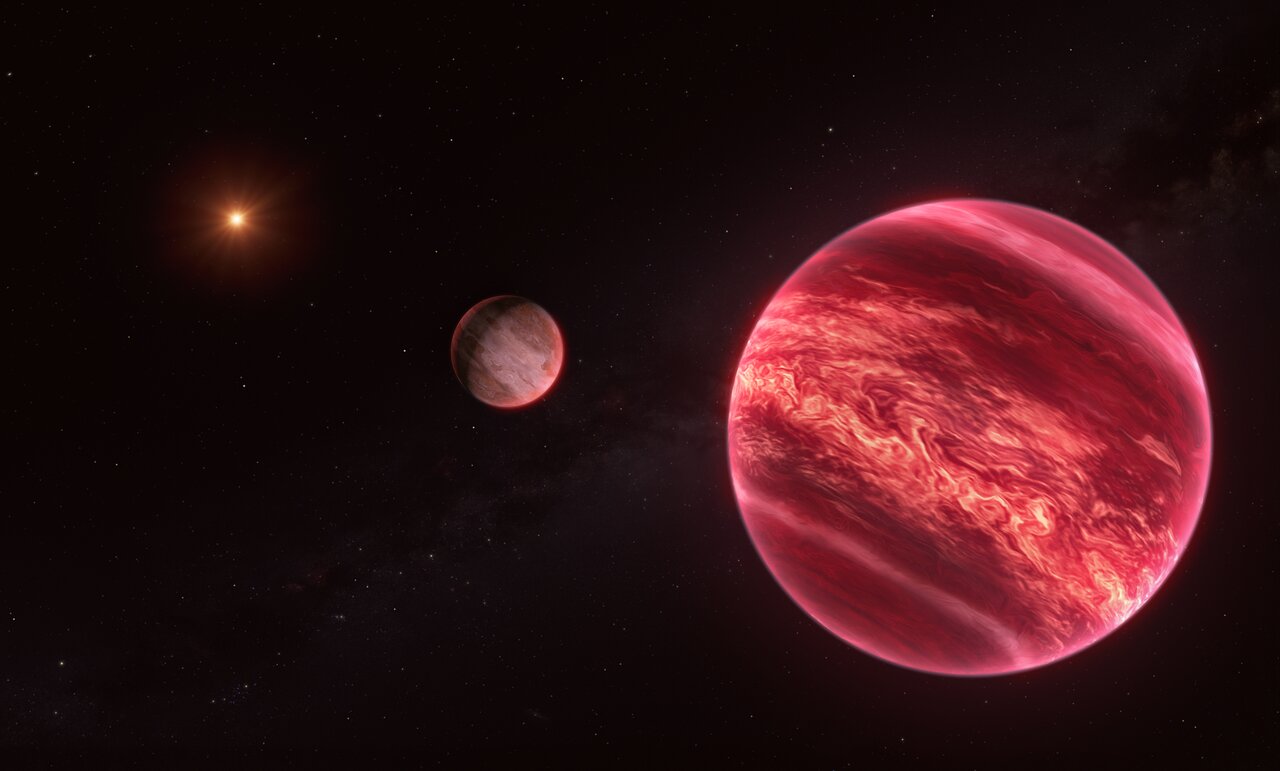
利用欧洲南方天文台(European Southern Observatory, ESO)的甚大望远镜(Very Large Telescope, VLT)进行的观测,揭示了 CD-35 2722 系统中存在一个类卫星天体的证据。与我们太阳系(Solar System)中的卫星不同,这个新发现的天体并非围绕一颗行星(planet)运行,这引发了关于如何对其进行命名的疑问。相反,它围绕着一颗褐矮星(brown dwarf)运行,而这颗比行星更大的天体又在围绕 CD-35 2722 恒星(star)运行。如果得到证实,这可能是太阳系外发现的首颗“卫星”。
Observations made with the European Southern Observatory’s Very Large Telescope (ESO’s VLT) have revealed evidence for a moon-like object in the CD-35 2722 system. Unlike moons in our Solar System, the newly found object does not orbit a planet, raising questions about what to name it. Instead, it circles a brown dwarf, an object larger than a planet, that orbits the CD-35 2722 star. If confirmed, this could be the first ‘moon’ discovered outside our Solar System.
Kevin Hoy 是智利的一名 ESO 学生,也是今天发表在《Nature》杂志上的这项研究的第一作者。他将自己花费数月分析的这个系统描述为与我们自己的系统相比“超级怪异”。这个年轻系统中最大、质量最大的天体是 CD-35 2722 恒星,其质量约为太阳的一半。这颗恒星由一颗褐矮星环绕,褐矮星是一种质量太大而无法成为行星,但又太小而无法成为恒星的天体。新发现的天体正是围绕这颗褐矮星运行。
Kevin Hoy, an ESO student in Chile and lead author of the study published today in Nature, describes the system he spent months analysing as “super weird” compared to our own. The biggest and most massive object in this young system is the star CD-35 2722, which has about half the mass of the Sun. The star is being orbited by a brown dwarf, an object too massive to be a planet but too small to be a star. The newly discovered object orbits this brown dwarf.
“使用像‘行星’和‘卫星’这样基于太阳系的词汇来定义这个系统有些困难,”Hoy 表示,他同时也隶属于智利的迭戈波塔利斯大学(Universidad Diego Portales)和年轻系外行星及其卫星千年核(Millennium Nucleus of Young Exoplanets and their Moons, YEMS)。该团队将这个新天体称为系外卫星(exosatellite),其质量至少与木星(Jupiter)相当,而那颗褐矮星的质量则是木星的30多倍。“这颗系外卫星显然大到足以成为一颗行星,但它并不围绕恒星运行,尽管它围绕着一个围绕恒星运行的天体,”Hoy 说。“作为这个系统中的‘第三者’,我们想称它为卫星,即使它与我们太阳系中那些小型岩石卫星完全不同。”
“This system is somewhat hard to define using Solar-System-based words like ‘planet’ and ‘moon’,” states Hoy, who is also affiliated with the Universidad Diego Portales and the Millennium Nucleus of Young Exoplanets and their Moons (YEMS) in Chile. The new object, which the team call an exosatellite, is at least as massive as Jupiter while the brown dwarf has more than 30 times the mass of Jupiter. “The exosatellite is clearly massive enough to be a planet, but it does not orbit a star, though it orbits an object that orbits a star," says Hoy. "Being the third wheel in this system makes us want to call it a moon, even if it is nothing like the small, rocky moons we have in our system.”
这个系外卫星或称“系外卫星”,即太阳系外的一种天然卫星(natural satellite)[1],由于该系统与我们自己的系统存在差异,因此很难对其进行分类。YEMS 主任兼该研究的合作者 Alice Zurlo 解释道:“我们报告的这颗卫星是一个巨大的气态天体,围绕着一颗质量极大的伴星运行,而这颗伴星本身的质量也是木星的数倍。”
This exosatellite or ‘exomoon’, a natural satellite outside our Solar System [1], is difficult to label, given the differences in this system compared to our own. Alice Zurlo, YEMS Director and collaborator on the study explains: “The satellite we report is a giant gaseous body orbiting a highly massive companion, itself several times the mass of Jupiter.”
“在太阳系中,行星和太阳之间有明确的界限,因此定义卫星之类的事物很简单。而在 CD-35 2722 系统中,我们模糊了恒星、行星和卫星之间的界限,整个描述过程变得更加复杂,”同时也是迭戈波塔利斯大学天体物理学家(astrophysicist)的 Zurlo 补充道。
“We have a clear delineation between the planets and the Sun in the Solar System, so defining things like moons is simple. In the CD-35 2722 system, where we are blurring the lines between stars, planets, and moons, the whole thing becomes more complicated to describe,” adds Zurlo, who is also an astrophysicist at Universidad Diego Portales.
无论如何称呼这个天体,天文学家(astronomer)多年来一直试图探测太阳系外的卫星,但至今尚未有确凿的探测结果。因此,尽管迄今为止已经发现了6000多颗系外行星(exoplanet),但仅有少数系外卫星候选者被发现,且支持它们的证据有限。就在几个月前,由 Quentin Kral 领导的团队报告了利用 ESO 的甚大望远镜干涉仪(Very Large Telescope Interferometer)在 HD 206893 恒星系统(star system)中的观测结果,揭示了卫星的迹象,但并未做出确切探测。
Regardless of what to call this object, astronomers have been trying to detect satellites outside our Solar System for years, but none has yet been confidently detected. Therefore, despite the over 6000 exoplanets discovered to date, only a few exomoon candidates have been spotted and the evidence to support them is limited. Just a few months ago, a team led by Quentin Kral reported on observations with ESO’s Very Large Telescope Interferometer in the HD 206893 star system, which revealed hints of a satellite, but no firm detection.
对于 CD-35 2722 的观测,Hoy、Zurlo 及其团队使用了 ESO VLT 上的 CRIRES+ 仪器,采用了曾用于发现首颗围绕类太阳恒星(Sun-like star)运行的系外行星的方法。他们应用这种径向速度(radial velocity)方法探测到了褐矮星因受该天体环绕而产生的微小摆动,并发现了团队认为支持该“卫星”存在的有力证据。“尽管它很奇特,但这个系统确实独一无二,代表了一项突破:首次对系外卫星的合理探测,”Zurlo 说。
For the CD-35 2722 observations, Hoy, Zurlo and their team used the CRIRES+ instrument on ESO’s VLT, employing the method that was used to find the first exoplanet around a Sun-like star. They applied this radial velocity method to detect small wobbles on the brown dwarf caused by the object orbiting it, finding what the team believe to be strong evidence for this ‘moon’. “As exotic as it is, this system is truly unique and represents a breakthrough: the first plausible detection of an exosatellite,” says Zurlo.
除了发现新型天体带来的兴奋之外,探测其他行星系(planetary system)中的卫星还可以帮助我们了解它们的形成和演化可能有多么多样化。凭借其39米的主镜和先进的仪器,ESO 即将建成的特大望远镜(Extremely Large Telescope, ELT)将使天文学家能够探测到更小的系外卫星。利用 ELT 取得的发现将促使我们进一步重新思考如何对来自不同于我们自身系统的行星天体进行分类。
Beyond the excitement of discovering new types of objects, detecting satellites in other planetary systems can help us understand how diverse their formation and evolution might be. With its 39-metre mirror and advanced instrumentation, ESO’s upcoming Extremely Large Telescope (ELT) will allow astronomers to detect smaller exomoons. Discoveries with the ELT will make us further reconsider how we label planetary objects from systems different from our own.
注释
Notes
[1] 卫星是围绕另一个天体运行的天体,可以是天然的(如我们的月球)或人造的(如航天器)。系外卫星是太阳系外的一种卫星。系外卫星通常被认为是围绕太阳系外行星或其他天体运行的天然卫星,尽管目前对于系外卫星还没有官方认可的定义。
[1] A satellite is an object that orbits another object and it can be natural (like our own moon) or artificial (like a spacecraft). An exosatellite is a satellite outside our Solar System. An exomoon is generally considered to be a natural satellite orbiting a planet or another object outside the Solar System, though there is no officially accepted definition for exomoon.