内容提要
天文学家利用甚大望远镜获得了参宿四伴星参宿四B迄今最清晰的图像。这一发现证实了这颗著名的红超巨星并非孤立存在,并为研究其演化过程提供了新视角。
原文全文译文
新闻稿
Press Release
天文学家发现参宿四(Betelgeuse)拥有伴星的最有力证据
Astronomers find strongest evidence yet that Betelgeuse has a companion
“百年探索的终章”
“The conclusion of a century-long quest”
2026年7月28日
28 July 2026
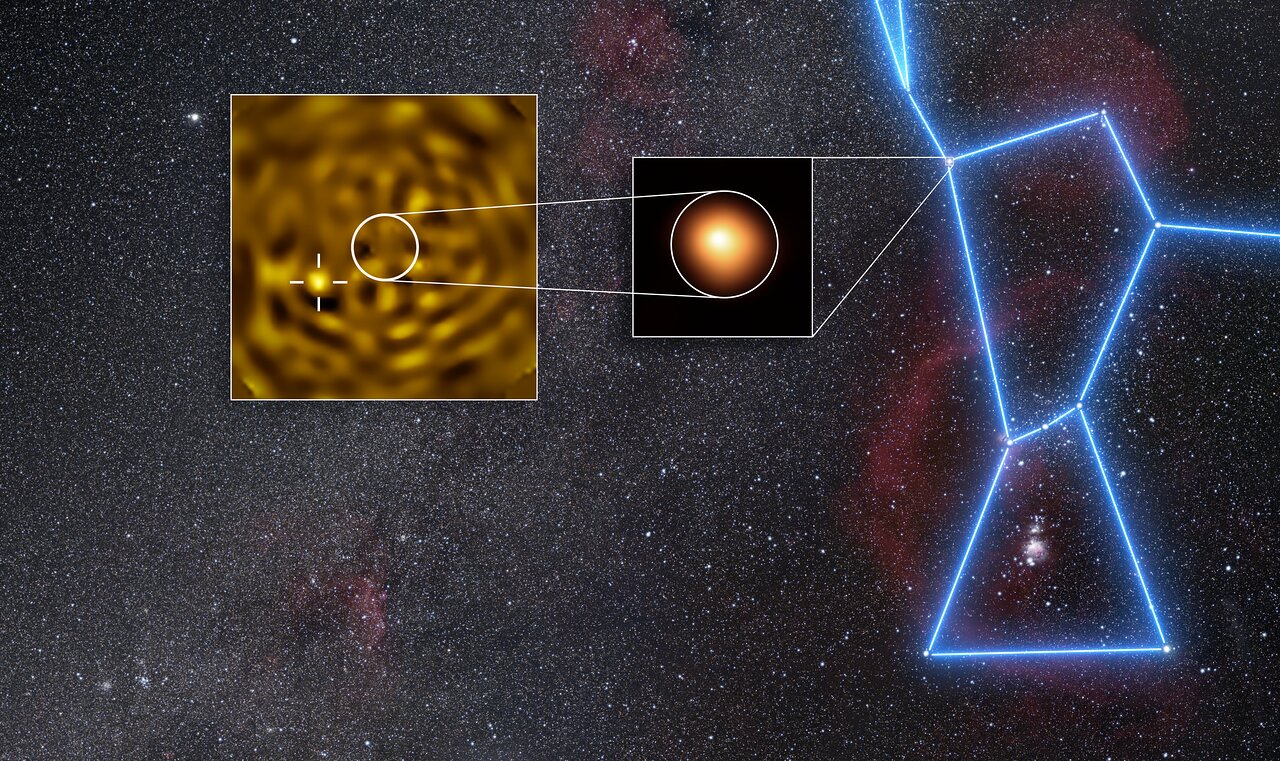
天文学家(astronomer)终于获得了确凿证据,证明夜天(night sky)中最著名的恒星(star)之一——参宿四并非孤身一人。由法国研究员Miguel Montargès领导的团队利用欧南台(European Southern Observatory,ESO)的甚大望远镜(Very Large Telescope,VLT),获得了迄今为止最清晰的图像,显示这很可能就是绕参宿四运行的恒星——参宿四B。Montargès表示:“这是百年探索的终章。”
At long last, astronomers have firm evidence that Betelgeuse, one of the most famous stars in the night sky, is not alone. Using the European Southern Observatory’s Very Large Telescope (ESO's VLT), a team led by French researcher Miguel Montargès obtained the clearest image ever of what likely is Betelgeuse B, the star orbiting Betelgeuse. “This is the conclusion of a century-long quest,” says Montargès.
“我们已经证明参宿四并非单星,它有一颗暗淡的伴星(companion star)相伴,”法国巴黎天文台(Observatoire de Paris)- PSL的天文学家、今日发表于《天体物理学》(Astronomy & Astrophysics)期刊的研究论文第一作者Montargès说道。参宿四是猎户座(Orion)中一颗肉眼(naked eye)清晰可见且以亮度变化闻名的红褐色恒星,它已被观测了数千年,但至今仍不断给天文学家带来惊喜。
“We have shown that Betelgeuse is not single, it is accompanied by a faint stellar companion,” says Montargès, astronomer at the Observatoire de Paris - PSL, France, and lead author of the study published today in Astronomy & Astrophysics. Betelgeuse — a reddish star in the Orion constellation that is easily visible with the naked eye and is known to change in brightness — has been observed for millennia. But it still surprises astronomers.
“当我看到处理后的图像时,我从椅子上跳了起来,”Montargès回忆道。天文学家寻找这颗潜在伴星已有约一个世纪,最初提出该假设是为了解释参宿四的亮度变化,但此前一直未果。2024年发表的两项研究有力地预测,在当年12月,该伴星将运行至距离参宿四最远的位置,从而更容易被观测到。Montargès及其团队随即展开工作,于2024年12月利用甚大望远镜对该恒星进行了观测,并花费数月时间处理数据。
“I jumped from my chair when I saw the processed images,” recalls Montargès. Astronomers have looked for the potential companion, originally proposed to explain Betelgeuse’s brightness changes, for about a century, but without success. Two studies published in 2024 robustly predicted that in December that year, the companion would be furthest from Betelgeuse and hence easier to spot. Montargès and his team got to work, observing the star with ESO’s VLT in December 2024 and spending several months processing the data.
“老实说,我原以为我们的灵敏度不足以探测到预测中的参宿四B,”Montargès解释道,“但因为它比预想的质量更大,我们看到了它!”最初人们认为其质量约为太阳质量,但新的观测结果显示,参宿四B的质量约为太阳的二到三倍。“在这样一颗被深入研究的恒星周围,我们竟然还能发现一颗质量更大、比太阳更亮的近邻伴星,这非常了不起,”Montargès说,“这是科学中最美妙的时刻之一:看到全新的、意想不到的事物。”
“Honestly, I thought we did not have the sensitivity to detect Betelgeuse B as it was predicted,” explains Montargès. “Because it is more massive than predicted, we see it!” Originally thought to be about as massive as the Sun, the new observations reveal that Betelgeuse B has instead around two to three times the mass of the Sun. “The fact that we can still discover a nearby companion, more massive and brighter than the Sun, around such a well-studied star is remarkable,” says Montargès. “These are among the best moments in science: seeing something new, unexpected.”
参宿四B是通过直接成像被发现的,这意味着研究人员利用位于智利阿塔卡马沙漠的甚大望远镜上的SPHERE仪器,探测到了来自该恒星本身的光。尽管此前已有证据表明这颗伴星的存在,包括美国夏威夷双子座北望远镜(Gemini North Telescope)可能的直接探测,但这仍是迄今为止关于参宿四B最强有力的证据和最清晰的图像。合著者、同样来自巴黎天文台的天文学家Anthony Boccaletti表示:“看到SPHERE和最初为寻找系外行星(exoplanet)而开发的先进后处理技术,在探测像参宿四这样的大质量主序后星(evolved star)周围的伴星时表现得如此出色,真是令人惊叹。”
Betelgeuse B was directly imaged, meaning the light from the star itself was detected, using the SPHERE instrument on ESO’s VLT in Chile’s Atacama Desert. While there was evidence for the existence of this companion star, including a possible direct detection with the Gemini North Telescope in Hawaiʻi, USA, this is the strongest evidence for, and clearest image yet of, Betelgeuse B. “It is remarkable to see how SPHERE and advanced post-processing techniques, originally developed to find exoplanets, also excel at detecting a companion around a massive, evolved star like Betelgeuse," says co-author Anthony Boccaletti, also an astronomer at the Observatoire de Paris.
“为了确定伴星确实存在,我们还需要在一年后观测它运行到恒星的另一侧,但现在几乎没有怀疑的空间了,”Montargès补充道。
“To be certain that the companion is really there, we still need to observe it in one year on the other side of the star, but there is very little space left for doubt,” adds Montargès.
几年前,参宿四因亮度明显变暗而引起了天文学家和公众的广泛关注。作为一颗主序后星超巨星(supergiant star),参宿四预计最终会以超新星爆发(supernova explosion)的形式走向终结,这种变暗现象曾引发了一些关于它是否即将爆发的猜测。由Montargès领导的天文学家团队利用甚大望远镜对该恒星进行了研究,发现它实际上是被一团尘埃云遮挡了。
A few years back, Betelgeuse was the subject of attention from astronomers and non-astronomers alike when it visibly started dimming. As an evolved supergiant star, Betelgeuse is expected to die in a supernova explosion, and the dimming led some to speculate it could be about to explode. A group of astronomers led by Montargès studied the star with ESO’s VLT, finding it was instead obscured by a cloud of dust.
参宿四B的潜在发现将促使天文学家研究这颗伴星如何影响参宿四预期的超新星爆发。“这颗伴星是否会对这颗红超巨星(red supergiant)的演化产生影响,这个问题确实已经开启了,”Montargès总结道。
The potential detection of Betelgeuse B will prompt astronomers to investigate how the companion could affect Betelgeuse's anticipated supernova explosion. “The question is truly opened whether this companion is going to have an impact on the evolution of the red supergiant,” concludes Montargès.