内容提要
薇拉·鲁宾天文台发布了其首张时空遗珍巡天(LSST)相机拍摄的图像及科学目录,展示了著名的宇宙演化巡天领域。这张深空图像通过叠加数百次观测,呈现了超过五十万个星系,为天文学家研究宇宙历史提供了重要参考。
原文全文译文
照片发布:美国国家科学基金会(NSF)与能源部(DOE)薇拉·鲁宾天文台(Vera C. Rubin Observatory)开启著名宇宙演化巡天(COSMOS)领域的深空之窗
NSF–DOE Rubin Observatory Opens Deep Window on Famous Cosmic Field
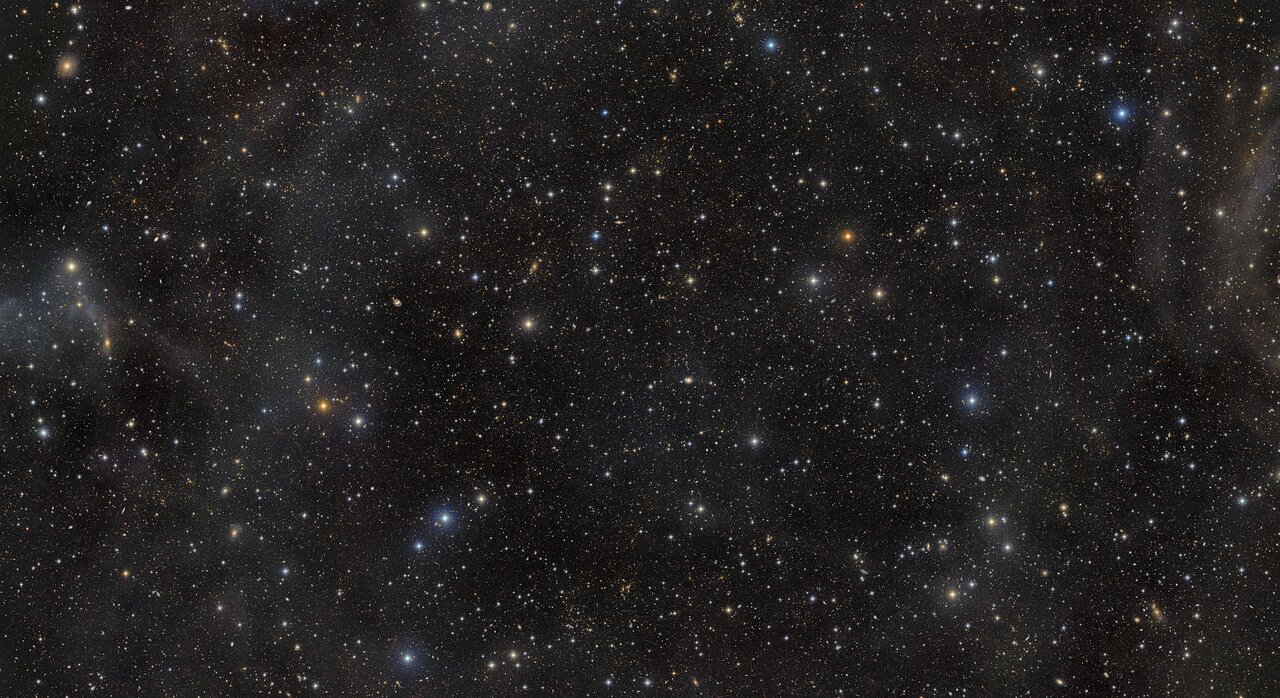
一张来自美国国家科学基金会(NSF)与能源部(DOE)薇拉·鲁宾天文台(Vera C. Rubin Observatory)的新图像,展示了宇宙演化巡天(COSMOS)领域内及周围数十万个遥远星系,标志着该天文台首次发布时空遗珍巡天(LSST)相机图像及科学目录。
A new NSF–DOE Vera C. Rubin Observatory image featuring hundreds of thousands of distant galaxies in and around the COSMOS field marks the Observatory’s first LSST Camera image and catalog release for science
2026年7月31日
31 July 2026
一张来自美国国家科学基金会(NSF)与能源部(DOE)薇拉·鲁宾天文台(Vera C. Rubin Observatory)的新图像,为被称为宇宙演化巡天(COSMOS)领域的著名天区提供了极其深邃的视野。COSMOS位于六分仪座(Sextans),是宇宙(universe)中观测次数最多的区域之一,而鲁宾天文台的这张新图像为这一著名的宇宙地标增添了强有力的全新视角。
A new image from NSF–DOE Vera C. Rubin Observatory offers a spectacularly deep view into a famous region of sky known as the COSMOS field. Located in the constellation Sextans, COSMOS is one of the most observed patches of the Universe — and Rubin’s new image adds a powerful new view of this well-known cosmic landmark.
鲁宾天文台的这张单幅图像中包含了多种不同类型的星系:拥有精致旋臂的螺旋星系、平滑的椭圆星系(elliptical galaxy)、扭曲的并合星系(merging galaxy),以及来自遥远宇宙的暗淡红色星系。只有少数几颗来自我们银河(Milky Way)的亮星(bright star)出现在前景中,使得人们能够异常清晰地观测到延伸至远方的星系。
Packed into this single image from Rubin Observatory are many different kinds of galaxies: spirals with delicate arms, smooth elliptical galaxies, distorted merging galaxies, and faint red galaxies from the distant Universe. Only a relatively small number of bright stars from our own Milky Way appear in the foreground, leaving an unusually clear view of galaxies stretching far into the distance.
鲁宾天文台由美国国家科学基金会(NSF)和美国能源部科学办公室(DOE/SC)共同资助。
Rubin Observatory is jointly funded by the U.S. National Science Foundation (NSF) and the U.S. Department of Energy's Office of Science (DOE/SC).
这张图像由鲁宾天文台的3.2吉像素时空遗珍巡天(LSST)相机拍摄——这是世界上最大的数码相机,安装在8.4米口径的西蒙尼巡天望远镜(Simonyi Survey Telescope)上。它呈现了被称为宇宙演化巡天(COSMOS)领域的著名且经过深入研究的天区。该图像通过叠加数百次独立观测而成,包含超过五十万个星系和超过50,000颗恒星(star)。
This image was captured with Rubin’s 3.2-gigapixel LSST Camera — the largest digital camera in the world, mounted on the 8.4-meter Simonyi Survey Telescope. It features the well-known and well-studied region of sky known as the COSMOS field. It was created by stacking hundreds of individual observations and contains more than half a million galaxies and more than 50,000 stars.
宇宙演化巡天(COSMOS)领域对天文学家(astronomer)而言极具价值,因为它避开了我们银河(Milky Way)拥挤的盘面。由于近距恒星(nearby star)和尘埃云遮挡较少,望远镜(telescope)可以观测到数量巨大的遥远星系,其中许多星系距离极其遥远,其光线在到达地球(Earth)之前已经传播了数十亿年。深入观测太空也意味着回溯更久远的时间,使科学家能够研究宇宙历史中处于不同演化阶段的星系。
The COSMOS field is especially valuable to astronomers because it looks away from the crowded plane of our Milky Way. With fewer nearby stars and clouds of dust blocking the view, telescopes can see enormous numbers of distant galaxies, many so far away that their light has traveled for billions of years before reaching Earth. Looking deeper into space also means looking farther back in time, allowing scientists to study galaxies at many different stages in the history of the Universe.
天文学家(astronomer)对宇宙演化巡天(COSMOS)的研究已超过二十年。自2003年哈勃空间望远镜(Hubble Space Telescope)开始观测以来,世界各地的研究人员已将全球许多领先的望远镜指向同一区域,在从射电波(radio wave)到X射线的波段范围内对其进行观测。由于该领域已被广泛观测,它成为了测试新数据、比较测量结果以及整合来自多个天文台(Observatory)信息的重要参考点。
Astronomers have studied COSMOS for more than two decades. Beginning with observations by the Hubble Space Telescope in 2003, researchers around the world have pointed many of the world’s leading telescopes at this same area, observing it in wavelengths ranging from radio waves to X-rays. Because the field has been observed so extensively, it serves as an important reference point for testing new data, comparing measurements, and combining information from many observatories.
鲁宾天文台现在为这一熟悉的领域带来了新事物:深度、广角覆盖和重复观测的结合。通过利用时空遗珍巡天(LSST)相机对宇宙演化巡天(COSMOS)进行反复成像,鲁宾天文台将补充早期的观测结果,并增加对该领域的动态视角。这种视角将帮助天文学家不仅研究遥远星系的外观,还能研究天空随时间的变化。
Rubin now brings something new to this familiar field: a combination of depth, wide-field coverage, and repeated observations. By imaging COSMOS again and again with the LSST Camera, Rubin will complement earlier observations and add a dynamic view of the field. This perspective will help astronomers study not only what distant galaxies look like, but also how the sky changes over time.
由于其科学价值,宇宙演化巡天(COSMOS)领域是被纳入时空遗珍巡天(LSST)——即鲁宾天文台旨在创建史上最全面、电影级宇宙记录的十年巡天计划——中观测频率最高的区域之一。通过增加观测次数,鲁宾天文台将创造出更深邃的视野,揭示出比这张首张图像中更暗淡的星系和更精细的细节。
Because of its scientific value, the COSMOS field is among the regions that will be observed more frequently than most areas included in the Legacy Survey of Space and Time (LSST) — Rubin’s ten-year survey aimed at creating the most comprehensive, cinematic record of the Universe in history. With added observations, Rubin will create an even deeper view, revealing fainter galaxies and finer details than can be seen in this first image.
这张图像于今日发布,以纪念鲁宾天文台的早期数据预览2(EDP2)——即鲁宾数据预览2发布的初相(first phase)。EDP2是鲁宾天文台首个基于时空遗珍巡天(LSST)相机观测数据的数据预览[1]。它结合了鲁宾天文台在2025年4月至2026年1月期间收集的科学验证观测数据。它为鲁宾科学界提供了一张覆盖3000平方度(square degree)夜天(night sky)的深度叠加图像,约占整个可见南半球(southern hemisphere)天空的六分之一。
This image is being released today to mark the occasion of Rubin’s Early Data Preview 2, or EDP2 — the first phase of Rubin’s Data Preview 2 release. EDP2 is Rubin’s first data preview based on observations from the LSST Camera [1]. It combines Rubin’s science validation observations collected between April 2025 and January 2026. It provides the Rubin science community with a deep co-added (stacked) image covering 3000 square degrees of night sky, which is around one-sixth of the entire visible Southern Hemisphere sky.
“宇宙演化巡天(COSMOS)的深度图像对鲁宾天文台在该区域的探索而言仅仅是个开始。在未来几年内对该领域的重复访问,将通过为我们的科学界提供大量瞬变和变源(如超新星和其他爆炸性瞬变源)以供随动(follow-up)和详细研究,展示我们巡天设计在发现方面的强大能力,”美国国家光学红外天文研究实验室(NOIRLab)鲁宾天文台主任Bob Blum表示。
“The COSMOS deep image is just the beginning for Rubin in this region. Repeated visits to the field over the next few years will demonstrate the power of our survey design for discovery by providing our science community with a huge number of transient and variable objects like supernovae and other explosive transients for follow-up and detailed study,” says Bob Blum, Director of Rubin Observatory at NSF NOIRLab.
虽然EDP2并非完整时空遗珍巡天(LSST)的数据发布(该巡天近期才刚刚开始),但它本身就是一份具有科学价值的数据发布。该数据预览为科学家提供了南半球天空的丰富视野,同时允许鲁宾科学界测试工具、验证数据产品,并为即将到来的十年巡天做好准备。值得注意的是,EDP2包含了宇宙演化巡天(COSMOS)领域,以及鲁宾天文台为庆祝时空遗珍巡天(LSST)开始而发布的“星之海洋”(Ocean of Stars)图像所覆盖的天区。
While EDP2 is not a release of data from the full LSST, which has only recently begun, it is a scientifically valuable data release in and of itself. The data preview gives scientists a rich look at the Southern Hemisphere sky, while allowing the Rubin science community to test tools, validate data products, and prepare for the decade-long survey ahead. Notably, EDP2 includes the COSMOS field, as well as the region of sky captured in Rubin’s Ocean of Stars image, which was released to celebrate the beginning of the LSST.
“宇宙演化巡天(COSMOS)领域对于时空遗珍巡天(LSST)科学来说非常重要,”SLAC鲁宾天文台副主任Phil Marshall说。“它丰富的既往观测资料,以及在调试期间和作为时空遗珍巡天(LSST)深场之一的重复目标定位,将使其成为科学家在准备处理巡天数据时极具价值的测试场。”
“The COSMOS field is a very important one for LSST science,” says Phil Marshall, Deputy Director of Rubin Observatory at SLAC. “Its wealth of prior observations, and its repeated targeting both during commissioning and as one of the LSST’s deep fields, will make it very valuable as a testing ground for scientists as they get ready to take on the survey data.”
通过对宇宙演化巡天(COSMOS)的这一新视角,鲁宾天文台提供了对未来科学的早期一瞥:一个极其深邃且广阔的宇宙视野,揭示了庞大的遥远星系群体以及地球(Earth)上空不断变化的天空。访问鲁宾天空查看器(Rubin Skyviewer)应用程序,以探索该领域的更多细节。
With this new view of COSMOS, Rubin offers an early glimpse of the science to come: an extraordinarily deep and wide view of the Universe, revealing both the vast population of distant galaxies and the changing sky above Earth. Visit the Rubin Skyviewer app to explore this field in more detail.
Bob Blum 补充道:“在我们庆祝鲁宾天文台(Rubin Observatory)开启科学观测之际,我们的心与我们的员工以及智利科金博(Coquimbo)地区及周边受近期毁灭性风暴影响的社区同在。我们的首要任务是确保该地区员工的福祉,并支持我们生活和工作的社区。这张标志着时空遗珍巡天(LSST)科学观测开启的图像,旨在献给科金博地区的民众,以此表达我们对他们几十年来支持天文学以及大学天文研究联合组织(AURA)在智利的天文台工作的感激之情。”
Bob Blum adds: “As we celebrate the start of science with Rubin Observatory, our thoughts are with our staff and the community of Chile impacted by the recent devastating storms in the region of Coquimbo and beyond. Our priority is to ensure the well-being of our staff in the region and support the community where we live and work. This image marking the start of LSST science is dedicated to the people of the region of Coquimbo and is a small token of our gratitude for their decades of support for astronomy and the AURA Observatories in Chile.”
EDP2 的第二阶段预计在 2026 年 10 月至 12 月期间进行,届时将增加源自单次图像的产品。这包括来自单次观测的已处理访问图像、仅显示探测到变化的差异图像,以及用于与单次访问图像进行比较以生成差异图像的模板图像。
The second phase of EDP2, expected in the October–December 2026 timeframe, will add products derived from individual images. This includes the processed visit images from individual observations, difference images that show only detected changes, and the template images, which are compared to the individual visit images to produce the difference images.
目前,美国和智利的研究人员以及获得授权的国际鲁宾数据权限持有者均可访问 EDP2。根据鲁宾天文台的数据访问政策,这些数据产品将在两年的专有期后向公众公开。
Access to EDP2 is available right now to researchers in the U.S. and Chile, as well as authorized international Rubin data-rights holders. In keeping with Rubin Observatory’s data-access policy, the data products will be made openly available to the public after a two-year proprietary period.
注释
Notes
[1] 鲁宾天文台于 2025 年 6 月发布的数据预览 1(DP1)包含了 2024 年 10 月至 12 月期间使用 LSST 调试相机(LSST Commissioning Camera)进行的观测数据——该相机是用于执行测试活动的 LSST 相机的一个缩小版本。
[1] Rubin’s Data Preview 1 (DP1), released in June 2025, contained observations from October–December 2024 taken with the LSST Commissioning Camera — a much smaller version of the LSST Camera that was used to conduct test campaigns.