内容提要
最新的DESI遗珍成像巡天(DESI Legacy Imaging Surveys)地图历时13年完成,覆盖了四分之三的夜天并编录了近四十亿个天体。该地图不仅是构建史上最大宇宙三维地图的基础,也为研究暗能量和暗物质等物理学谜题提供了重要数据。
原文全文译文
科学家发布史上最大宇宙二维地图
Scientists Release Biggest 2D Map of the Universe
全新的DESI遗珍成像巡天(DESI Legacy Imaging Surveys)地图为史上最大的宇宙三维地图奠定了基础,该地图被用于研究暗能量。
The new DESI Legacy Imaging Surveys map serves as the foundation for the largest-ever 3D map of the Universe, used to investigate dark energy
2026年8月10日
10 August 2026
最新的DESI遗珍成像巡天地图历时13年制作完成,覆盖了四分之三的夜天(night sky),并编录了近四十亿个天体(celestial object)。这一宝库向所有人开放,其中包含了恒星(star)、星系、超新星、引力透镜(gravitational lens)等丰富内容。美国国家光学红外天文研究实验室(NOIRLab)旗下的两处设施为该地图贡献了数据:美国国家科学基金会(NSF)的Mayall望远镜,以及配备了美国能源部制造的DECam的NSF Blanco望远镜。
The newest DESI Legacy Imaging Surveys map, 13 years in the making, covers three-quarters of the sky and catalogs nearly four billion objects. This treasure trove is available to all and contains stars, galaxies, supernovae, gravitational lenses, and much more. Two NSF NOIRLab facilities contributed data to the map: the U.S. National Science Foundation (NSF) Mayall telescope and the NSF Blanco telescope, equipped with the U.S. Department of Energy-fabricated DECam.
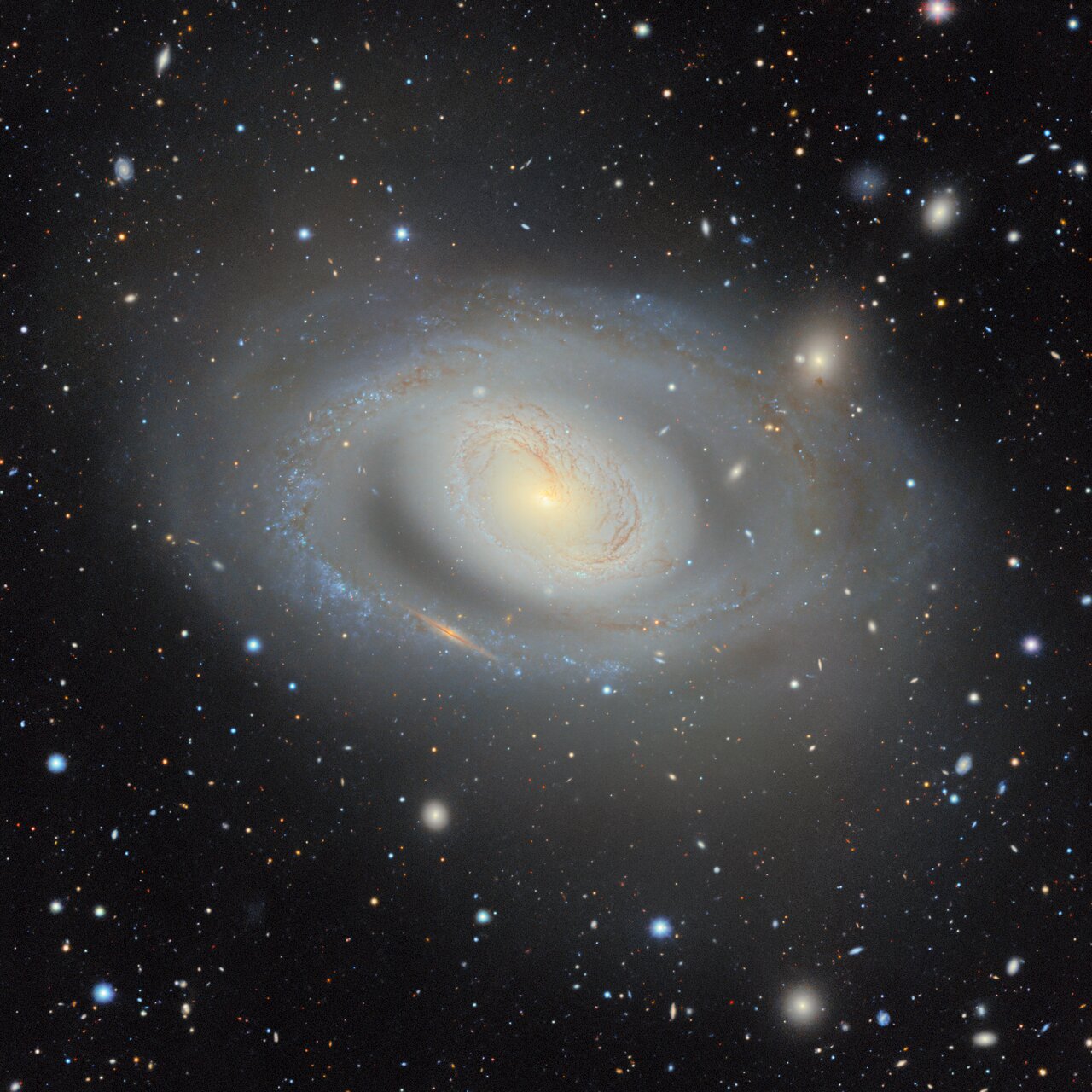
准备好你们的望远镜(telescope):DESI遗珍成像巡天团队发布了史上最大的宇宙二维地图。这张拥有5.6万亿像素的地图包含了近四十亿个天体,包括恒星、星系、黑洞(black hole)和小行星(asteroid)。这些数据可供所有人使用,并可通过Legacy Survey Sky Viewer公开查看。
Hold on to your telescopes: the DESI Legacy Imaging Surveys team has released the largest-ever 2D map of the Universe. The 5.6-trillion-pixel map contains nearly four billion celestial objects, including stars, galaxies, black holes, and asteroids. The data are available for all to use and are publicly viewable through the Legacy Survey Sky Viewer.
天文学家(astronomer)和公民科学家可以将该地图与他们自己的观测结果相结合,以更好地理解我们的宇宙(universe)。研究人员可以搜索引力透镜等罕见现象,观测超新星等瞬时事件,并调查物理学中两大最大的谜题:暗物质(dark matter),即占我们宇宙大部分质量的无形物质;以及暗能量(dark energy),即驱动我们宇宙加速膨胀的力量。
Astronomers and citizen scientists can combine the map with their own observations to better understand our Universe. Researchers can search for rare phenomena like gravitational lenses, observe fleeting events like supernovae, and investigate two of physics’ biggest mysteries: dark matter, the invisible substance that accounts for most of the mass in our Universe, and dark energy, the force driving our Universe’s accelerating expansion.
这张新地图建立在DESI遗珍成像巡天早期版本的基础上,这些版本已被证明具有不可估量的价值。迄今为止,已有超过1800篇科学论文引用了遗珍巡天(Legacy Surveys)的数据。
The new map builds on earlier versions from the DESI Legacy Imaging Surveys that have already proved invaluable. To date, more than 1800 science papers have been published referencing the Legacy Surveys’ data.
“它现在已成为天文学(astronomy)研究结构的一部分,”遗珍巡天联合负责人、能源部劳伦斯伯克利国家实验室(Berkeley Lab)的科学家David Schlegel说。“当你今天处理天体时,通常会先打开遗珍成像查看器(Legacy Imaging Viewer)来看看你正在观察什么。”
“It’s part of the fabric of astronomy research now,” says David Schlegel, a co-lead of the Legacy Surveys and scientist at the Department of Energy’s Lawrence Berkeley National Laboratory (Berkeley Lab). “When you're working with astronomical objects today, you often start by pulling up the Legacy Imaging Viewer to see what you’re looking at.”
这张更新后的地图覆盖了约75%的可见光和近红外(near-infrared)波段夜天,提供了不受我们银河(Milky Way)尘埃和恒星遮挡的河外宇宙深空视野。研究人员预计,在未来几年内,它仍将是关于我们宇宙最全面的二维地图。
Covering roughly 75% of the sky in visible and near-infrared light, the updated map provides a deep view of the extragalactic Universe not blocked by the dust and stars of our own Milky Way. Researchers expect it will remain the most comprehensive 2D map of our Universe for years to come.
超过160名科学家为该项目的资料收集做出了贡献,一个由20人组成的团队制作了今天发布的最终数据集。它是由来自三个地面巡天观测(sky survey)项目的263,407次望远镜曝光数据合并而成:
More than 160 scientists contributed to data collection for the project, and a team of 20 produced the final dataset released today. It was built by combining 263,407 telescope exposures from three ground-based sky surveys:
- 暗能量相机遗珍巡天(DECaLS),由安装在美国国家科学基金会(NSF)托洛洛山美洲天文台(CTIO,NOIRLab的一个项目)的Víctor M. Blanco 4米望远镜上的5.7亿像素能源部制造的暗能量相机(DECam)执行。
- The Dark Energy Camera Legacy Survey (DECaLS), conducted by the 570-megapixel Department of Energy-fabricated Dark Energy Camera (DECam), mounted on the U.S. National Science Foundation (NSF) Víctor M. Blanco 4-meter Telescope at NSF Cerro Tololo Inter-American Observatory (CTIO), a Program of NSF NOIRLab.
- Mayall z波段遗珍巡天(MzLS),由美国国家科学基金会(NSF)基特峰国家天文台(KPNO,NOIRLab的一个项目)的Nicholas U. Mayall 4米望远镜执行。
- The Mayall z-band Legacy Survey (MzLS), conducted by the NSF Nicholas U. Mayall 4-meter Telescope at NSF Kitt Peak National Observatory (KPNO), a Program of NSF NOIRLab.
- 亚利桑那大学斯图尔德天文台(Steward Observatory)的北京-亚利桑那巡天(BASS),使用KPNO的UA Bok 2.3米望远镜进行,并辅以美国[国家]航天局(NASA)广域红外巡天探测器(WISE)卫星(satellite)任务多年的数据。
- The Beijing-Arizona Sky Survey (BASS) at the University of Arizona’s Steward Observatory, conducted with the UA Bok 2.3-meter Telescope at KPNO and supplemented by years of data from NASA’s Wide-field Infrared Survey Explorer (WISE) satellite mission.
除了扩展的文件集外,DESI遗珍巡天的完整数据目录还通过NOIRLab下属社区科学与数据中心(CSDC)的Astro Data Lab作为可搜索数据库提供。这些服务向整个天文学界开放,以促进数据获取和分析。
In addition to the extended file collection, the DESI Legacy Surveys’ full catalog of data is made available as a searchable database via the Astro Data Lab at the Community Science and Data Center (CSDC), a Program of NSF NOIRLab. These services are accessible to the entire astronomy community to facilitate data access and analysis.
“对我们宇宙的探索总是从夜天的图像开始。DESI遗珍成像巡天只是这一古老人类传统中的一步,”遗珍巡天联合负责人、NOIRLab天文学家Arjun Dey说。“对于我们的团队来说,这些数据对于研究宇宙的膨胀历史和我们银河的形成至关重要。但天空属于每个人,这次巡天让每个人都有机会惊叹于它的奇迹。”
“Explorations of our Universe always start with images of the night sky. The DESI Imaging Legacy Surveys are just one step in this venerable human tradition,” says Arjun Dey, co-lead of the Legacy Surveys and an astronomer at NSF NOIRLab. “For our team, these data are fundamental to the investigation of the expansion history of the Universe and the formation of our galaxy. But the skies belong to everyone, and this survey gives everyone the chance to marvel at their wonders.”
DESI遗珍成像巡天最初是为了配合暗能量光谱仪(DESI)巡天而进行的。遗珍巡天的二维地图本质上是一张深空天体照片;它记录了星系和恒星出现的位置以及它们的亮度。这一关键步骤使DESI能够选择目标并测量它们在不同波长下的光,从而确定它们的距离,进而构建出有史以来最大的高分辨率(high resolution)三维地图。科学家利用这张地图研究星系在宇宙不同年龄段的聚集方式,以追踪暗能量随时间的变化。
The DESI Legacy Imaging Surveys were originally conducted to prepare for the Dark Energy Spectroscopic Instrument (DESI) survey. The Legacy Surveys’ 2D map is essentially a deep photograph of the sky; it records where galaxies and stars appear and how bright they appear. This crucial step enables DESI to select objects and measure their light in different wavelengths to determine their distances, building the largest high-resolution 3D map ever made. Scientists use this map to study the way galaxies have clustered at different ages of the Universe to track dark energy over time.
2026年4月,DESI提前完成了其最初的五年巡天任务,观测到的天体数量远超预期。早期结果显示出令人惊讶的迹象,即暗能量的影响可能随时间减弱——这一范式转移可能会影响我们宇宙预期的命运。DESI预计将在2027年利用前五年的数据发布改进后的结果,并继续观测至2028年。
In April 2026, DESI completed its original five-year survey ahead of schedule and with vastly more objects than expected. The early results have shown surprising hints that dark energy’s impact may be weakening over time — a paradigm shift that could potentially shape the predicted fate of our Universe. DESI expects to publish improved results using its first five years of data in 2027 and is continuing observations into 2028.
除了支持DESI之外,遗珍巡天还将成为下一代望远镜的基础参考。随着由NSF和能源部科学办公室(DOE/SC)共同资助的薇拉·鲁宾天文台(Vera C. Rubin Observatory),以及南希·格雷丝·罗曼空间望远镜(Nancy Grace Roman Space Telescope)等新天文台投入使用,研究人员可以将他们的观测结果与有史以来最深、最全面的天空视图之一进行比较。
Beyond supporting DESI, the Legacy Surveys will be a foundational reference for the next generation of telescopes. As new observatories like NSF–DOE Vera C. Rubin Observatory, jointly funded by the NSF and DOE’s Office of Science (DOE/SC), and NASA’s Nancy Grace Roman Space Telescope come online, researchers can compare their observations with one of the deepest and most comprehensive views of the sky ever assembled.
遗珍巡天的数据还将帮助科学家训练人工智能工具,以分析拍字节(petabytes)级的天文学数据并加速新发现。它将成为能源部起源号探测器(Genesis)任务下美国科学云(American Science Cloud)内天体物理学试点项目所使用的数据集之一。
The Legacy Surveys’ data will also help scientists train artificial intelligence tools to analyze petabytes of astronomical data and accelerate new discoveries. It will be among the datasets used in an astrophysics pilot project within the American Science Cloud, part of the DOE’s Genesis Mission.