内容提要
美国国家航天局(NASA)与欧洲空间局(ESA)的哈勃空间望远镜发现了银河系早期演化阶段发生星系并合的确凿证据。这一发现将我们对银河系历史的认知向前推进了18亿年。
原文全文译文
heic2611 — 科学发布
heic2611 — Science Release
哈勃空间望远镜解开了银河系早期的并合之谜
Hubble solves merger mystery from Milky Way’s early years
2026年8月17日
17 August 2026
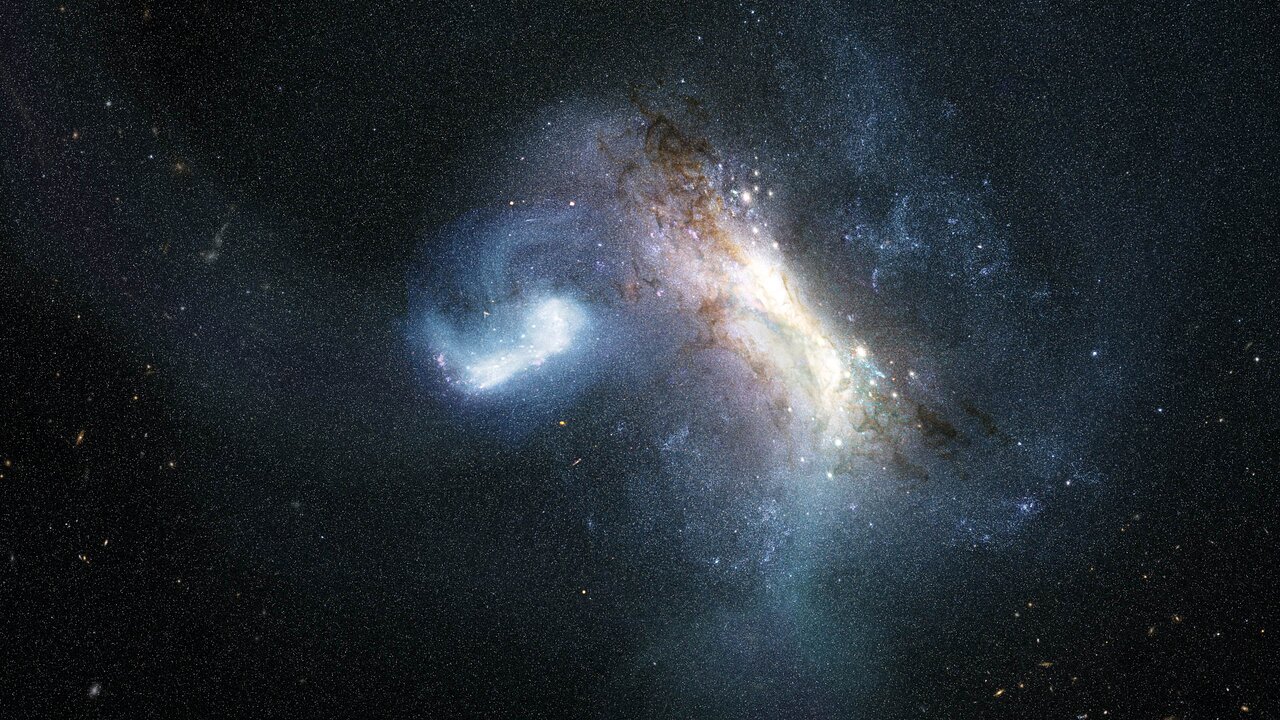
我们的家园银河系(Milky Way),其现今规模的形成部分归功于对较小星系的吞噬。如今,来自美国国家航天局(NASA)/欧洲空间局(ESA)哈勃空间望远镜(Hubble Space Telescope)的新数据,为银河系演化早期阶段一个矮星系(dwarf galaxy)的并合提供了确凿证据。这一发现将我们对银河系历史的认知向前推进了18亿年。
Our home galaxy, the Milky Way, grew to its current size in part by consuming smaller galaxies. Now, new data from the NASA/ESA Hubble Space Telescope show definitive evidence of a dwarf galaxy merging with the young Milky Way galaxy in the earliest phases of its evolution. This finding extends our knowledge of our galaxy’s history 1.8 billion years farther back in time than before.
研究结果已于今日发表在《天体物理和空间科学》(Nature Astronomy)期刊上。
The results were published today in the journal Nature Astronomy.
今日的银河系是一个拥有数千亿颗恒星(star)的巨大旋涡星系(spiral galaxy)。然而,我们的星系并非一直如此庞大;它通过从气体云(gas cloud)中形成新生星(new star),以及通过星系并合(galaxy merging)从其他星系收集恒星、气体和暗物质(dark matter)而不断成长。
The Milky Way today is a massive spiral galaxy home to hundreds of billions of stars. However, our galaxy wasn’t always so large; it has grown by forming new stars from its gas clouds as well as collecting stars, gas, and dark matter from other galaxies through mergers.
银河系历史上最近的一次大规模并合发生在人马座(Sagittarius)矮星系,始于60多亿年前,至今仍在持续。回溯到更遥远的过去,研究人员了解到银河系在100亿年前吞噬了另一个名为盖亚-香肠-土卫二(Gaia-Sausage-Enceladus)的矮星系。这次古老的并合极大地影响了银河系恒星盘的结构。在这两次并合之间,还发生过其他较小的并合事件。
The most recent massive merger in our galaxy’s history took place with the Sagittarius dwarf galaxy, beginning over 6 billion years ago and still ongoing today. Looking back into the even more distant past, researchers learned that the Milky Way galaxy consumed another dwarf galaxy called Gaia-Sausage-Enceladus 10 billion years ago. This ancient merger greatly affected the structure of our galaxy’s disk of stars. Other, smaller mergers occurred between these two.
但银河系的历史并未止步于此。观测和模拟都表明,在上述两次并合之前还发生过另一次大规模并合,尽管关于该事件的具体细节一直存在激烈争论。现在,哈勃空间望远镜发现了约118亿年前,即大爆炸后仅20亿年发生的一次更早并合的确凿证据。
But our galaxy’s history doesn’t stop there. Both observations and simulations have suggested that another large merger preceded these two, though the specifics of the event have been heavily debated. Now, Hubble has uncovered definitive evidence of an earlier merger that occurred about 11.8 billion years ago, or just 2 billion years after the Big Bang.
“我们的家园是银河系,但我们并不了解这座‘房子’是如何建造的,”意大利博洛尼亚天体物理和空间科学天文台(Astrophysics and Space Science Observatory of Bologna)的首席作者Davide Massari表示。“在这篇论文中,我们发现了第一批重要的‘砖块’来自何处:一个我们称之为LKH的矮星系。”
“Our home is the Milky Way galaxy, but we do not know how our house was built,” said Davide Massari, lead author, Astrophysics and Space Science Observatory of Bologna in Italy. “In this paper we discover where the first significant batch of bricks came from: a dwarf galaxy that we call LKH.”
宇宙考古遗址
Cosmic archaeological sites
巨大的天文巡天项目以及来自ESA盖亚(Gaia)任务等航天器的精确数据,在拼凑银河系历史方面发挥了重要作用。科学家试图回溯的银河系历史越久远,判断发生了什么就越困难。当银河系还年轻时,它的体积更小,与它发生碰撞的星系大小也更为接近。当时的环境也更加混乱,并合的痕迹很可能在数十亿年间已被抹去。
Immense astronomical surveys and precision data from spacecraft like ESA’s Gaia mission have been instrumental in piecing together the history of our galaxy. The farther back into our galaxy’s history that scientists attempt to look, the more difficult it becomes to tell what happened. When our galaxy was young, it was smaller and much closer in size to the galaxies it clashed with. It was also more chaotic, and it’s possible that the signs of mergers have been erased over billions of years.
哈勃空间望远镜正是深入到了这段模糊的过去进行观测。研究人员利用哈勃空间望远镜研究了银河系的一些球状星团(globular cluster):即由数万到数百万颗恒星组成的巨大、大致呈球形的集合体。球状星团包含着银河系中一些最古老的恒星,它们可以作为宇宙考古遗址,保存着银河系从其他星系收集来的恒星。
It’s into this murky past that Hubble peered. Researchers used Hubble to study some of the Milky Way galaxy’s globular clusters: immense, roughly spherical collections of tens of thousands to a few million stars. Globular clusters contain some of the oldest stars in our galaxy, and they can act as cosmic archaeological sites that preserve stars from other galaxies the Milky Way galaxy has collected.
“得益于哈勃空间望远镜的高分辨率(high resolution)和深度成像,我们能够以空前的精度测量这些星团的年龄和金属含量,”意大利博洛尼亚大学的研究合著者Chiara Zerbinati说。“结合盖亚任务的测量数据,这使得区分出一群与其他星团不同的球状星团成为可能。这些星团诞生于LKH,它们告诉了我们那个星系何时被我们的星系吞噬,以及它的质量有多大。”
“Thanks to the high resolution and depth of Hubble imaging, we could measure the age and the metal content of these clusters with unprecedented precision,” said Chiara Zerbinati, study co-author, University of Bologna in Italy. “Coupled with measurements from Gaia, this made it possible to distinguish a population of globular clusters that are different from the others. These are the clusters that were born in LKH, and they tell us when that galaxy was devoured by ours, and how massive it was.”
研究团队分析了哈勃空间望远镜对银河系内部20000光年(light year)范围内39个球状星团的观测结果,这里应当保存着最古老并合的证据。他们预计该样本中既包含在年轻银河系内形成的球状星团,也包含约100亿年前从盖亚-香肠-土卫二矮星系中收集的星团。
The team analysed Hubble observations of 39 globular clusters in the inner 20,000 light-years of our galaxy, where evidence of the most ancient mergers should be preserved. They expected this sample to contain globular clusters that formed within the young Milky Way galaxy as well as those collected from the Gaia-Sausage-Enceladus dwarf galaxy about 10 billion years ago.
利用哈勃空间望远镜的灵敏观测来确定每个星团的精确年龄及相关的金属丰度(abundance of element)——即比氦重的元素丰度——他们确定在银河系内部区域存在第三类球状星团。研究团队发现,无论金属含量如何,这些星团都比盖亚-香肠-土卫二并合事件中收集的星团更古老,但比在银河系内诞生的星团更年轻。因此,这些星团来自一次独立且更早的并合——在这次并合中,银河系吸收了一个恒星质量约为太阳5亿倍的矮星系,这占了当时银河系质量的很大一部分。他们将这个矮星系命名为Low-energy-Kraken-Heracles,简称LKH,以纪念三篇早期支持银河系历史早期并合观点的研究论文。
Using Hubble’s sensitive observations to determine each cluster’s precise age and associated metallicity — the abundance of elements heavier than helium — they determined there was a third population of globular clusters in the inner regions of our galaxy. The team found that these clusters are older than the group collected in the Gaia-Sausage-Enceladus merger, but younger than those born in the Milky Way, regardless of their metal content. These clusters, therefore, came from a separate and even earlier merger — in which the Milky Way galaxy absorbed a dwarf galaxy containing roughly 500 million times the mass of the Sun in stars, a significant fraction of our galaxy’s mass at the time. They named this dwarf galaxy Low-energy-Kraken-Heracles, or LKH, in honor of three earlier research papers that championed the idea of a merger early in our galaxy’s history.
在银河系形成如此早期的阶段发生如此大规模的并合,对银河系的演化具有深远的影响。
Such a large merger so early in the Milky Way galaxy’s formation has profound implications for the evolution of our galaxy.
“过去的一些研究认为,银河系演化的最早阶段仅由银河系内诞生的恒星所定义,”Massari说。“在这里,我们证明了在河外星系(external galaxy)中诞生的恒星也需要被纳入考量。”
“Some past studies have argued that the earliest phases of our galaxy’s evolution were defined by stars born only in our galaxy,” says Massari. “Here, we have shown that stars born in external galaxies also need to be considered.”
该团队计划继续通过研究银河系的球状星团来揭开银河系的历史,旨在刻画银河系在整个宇宙历史中所经历的所有大规模并合事件。
The team plans to continue their work to unravel the history of the Milky Way galaxy by studying its globular clusters, aiming to characterise all the massive mergers that our galaxy has experienced across cosmic history.
“哈勃空间望远镜正在观测从未被研究过的球状星团,这将帮助我们刻画银河系历史上遥远过去的并合事件,”西班牙维戈大学和拉古纳大学的合著者Fernando Aguado-Agelet表示。
“Hubble is observing globular clusters that have never been studied before, and this will help us characterise the merger events that are far back in time in the Milky Way galaxy’s history,” said Fernando Aguado-Agelet, co-author, University of Vigo and the University of La Laguna in Spain.