
查看原文全部插图(5 幅)


内容提要
欧洲空间局(ESA)的火星快车(Mars Express)通过高分辨率影像,带我们领略了火星上最大的撞击坑之一——斯基亚帕雷利巨爵座。这段视频结合了地形数据与大气效应,生动还原了该区域的地貌特征。
原文全文译文
欧洲空间局(ESA)的火星快车(Mars Express)再次带我们进行了一次迷人的飞行,这次我们环绕的是火星(Mars)上最大的巨爵座(Crater)之一。
ESA’s Mars Express takes us on another mesmerising flight, this time around one of the biggest craters on Mars.
尽管斯基亚帕雷利巨爵座的直径高达460公里,但它看起来相对较浅。也许在过去的几十亿年里,它已经被风吹来的沉积物、水流沉积物、熔岩,或者这三者的共同作用所填平。
Despite measuring a huge 460 km across, Schiaparelli Crater seems to be relatively shallow. Perhaps it has been filled in over the last few billion years by sediment blown by the wind or deposited by water, by lava – or by a combination of all three.
斯基亚帕雷利巨爵座是以意大利天文学家(astronomer)Giovanni Schiaparelli(1835–1910)的名字命名的。尽管他曾研究过水星(Mercury)和金星(Venus),但他最出名的是对这颗红色行星(planet)的观测。
Schiaparelli Crater is named after Italian astronomer Giovanni Schiaparelli (1835–1910). Although he studied Mercury and Venus, he is best known for his observations of the Red Planet.
在1877年的“大冲”期间,当火星经过地球(Earth)附近时,Schiaparelli绘制了该行星的地图,并观察到红色表面上有几条笔直的暗线(dark line)。他推测这些是天然的充水通道,并使用了意大利语中对应的词汇“canali”。
During the ‘Great Opposition’ of 1877, when Mars passed close to Earth, Schiaparelli mapped the planet, perceiving several straight dark lines across the red surface. He assumed that these were natural water-filled channels and used the equivalent Italian word, ‘canali’.
然而,其他天文学家认为他指的是运河,即人工灌溉和运输路线,这导致一些天文学家和广大公众相信这些是由智慧火星人建造的。
However, other astronomers thought he meant canals, meaning artificial irrigation and transportation routes, which led to a few astronomers, and a large number of the general public, believing that they had been created by intelligent martians.
现在我们知道,Schiaparelli所说的“canali”是当时相对落后的望远镜(telescope)所产生的错觉,如今火星上并没有充水通道。尽管如此,我们确实相信该行星的这一区域曾经存在过水,或许是以湖泊的形式。
Now we know that Schiaparelli’s ‘canali’ were illusions created by the comparatively poor telescopes of the time and there are no water-filled channels on Mars today. Nevertheless, we do believe that water was once present in this region of the planet, perhaps in the form of a lake.
斯基亚帕雷利巨爵座在流行文化中也很重要,它是Andy Weir的小说《火星救援》(The Martian)中宇航员Mark Watney的最终目的地。
Schiaparelli Crater is also important in popular culture, being the final destination of astronaut Mark Watney in Andy Weir’s novel ‘The Martian’.
享受这次飞行吧,记得调大音量以获得完整的音频导览体验。
Enjoy the flight, and be sure to turn up the volume for the full audio guide experience.
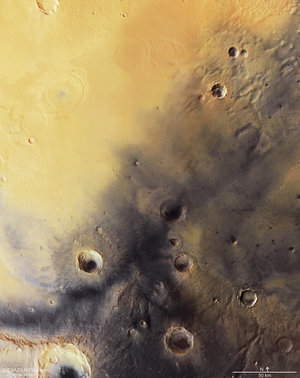
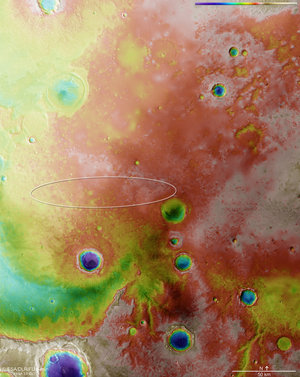
图注:本影片是利用火星快车的高分辨率立体相机火星图(HMC-30)数据制作的,这些影像镶嵌图由该任务的高分辨率立体相机(HRSC)多次观测所得。该镶嵌图以8°S/17°E为中心,结合了数字地形模型中的地形信息,生成了三维景观。
Processing notes:
影片的每一秒都由50个独立帧渲染而成,这些帧遵循场景中预设的摄像机路径。动画中使用的垂直夸张倍数为三倍。为了掩盖地形模型的局限性,添加了云和雾等大气效应(atmospheric effect)。雾气在250公里外开始积聚。
This film was created using the Mars Express High Resolution Stereo Camera Mars Chart (HMC-30) data, image mosaics made from multiple observations by the mission’s High Resolution Stereo Camera (HRSC). The mosaic image, centred at 8°S/17°E, is combined with topography information from the digital terrain model to generate a three-dimensional landscape.
火星快车上的HRSC相机由德国航空航天中心(DLR)操作。相机数据的系统处理是在柏林阿德勒斯霍夫的DLR空间研究(space research)研究所进行的。柏林自由大学的行星科学与遥感(remote sensing)工作组利用这些数据制作了这部影片。
For every second of the movie, 50 separate frames are rendered following a predefined camera path in the scene. The vertical exaggeration used for the animation is three-fold. Atmospheric effects, like clouds and haze, have been added to conceal the limits of the terrain model. The haze starts building up at a distance of 250 km.
The HRSC camera on Mars Express is operated by the German Aerospace Center (DLR). The systematic processing of the camera data took place at the DLR Institute for Space Research in Berlin-Adlershof. The working group of Planetary Science and Remote Sensing at Freie Universität Berlin used the data to create the film.
来源与许可
本站仅展示标题与摘要,正文版权归原作者及原发布机构所有。 原始页面