内容提要
天文学家利用甚大望远镜干涉仪(VLTI)发现了一颗名为S301的恒星,它是银河系中已知运行速度最快的恒星。该恒星绕人马A(Sagittarius A*)运行的轨道极近,使其成为直接测量黑洞自转的关键天体。
原文全文译文
新闻稿
Press Release
银河系最快恒星绕超大质量黑洞运行,距离近到能感受到其自转
Milky Way's fastest star orbits our supermassive black hole so closely it feels its spin
2026年8月19日
19 August 2026
天文学家在银河(Milky Way)中心发现了一颗已知运行速度最快的恒星,它正绕着那里的黑洞(black hole)运行。这颗名为S301的恒星是通过欧南台(European Southern Observatory, ESO)的甚大望远镜干涉仪(VLTI)探测到的,它在绕行这个四百万太阳质量(solar mass)的黑洞时,速度可达25 000 km/s。它与黑洞的距离比以往观测到的任何恒星都要近,近到足以感受到黑洞自转带来的影响。
Astronomers have discovered the fastest known star in our galaxy, the Milky Way, orbiting the black hole at its centre. The star, named S301, was detected with the European Southern Observatory’s Very Large Telescope Interferometer (ESO’s VLTI) and reaches speeds of 25 000 km/s as it travels around the four-million-Solar-mass black hole. It comes closer to it than any other observed before, so close that it feels the effects of the black hole’s rotation.
“几十年来,我们一直在仔细追踪绕银河中心黑洞——人马A(Sagittarius A*)运行的恒星,这最终促成了这一非常有前景的恒星的突破性发现。由于S301绕人马A运行的距离极近,它为我们打开了一扇了解这一极端黑洞环境中时空基本性质的新窗口,”诺贝尔奖得主、德国加兴马克斯·普朗克地外物理研究所(MPE)所长、促成此次新观测的合作项目创始成员Reinhard Genzel表示。
“Decades carefully tracking stars orbiting our galaxy’s central black hole, Sagittarius A*, have led to this breakthrough discovery of a very promising star. Because it orbits so close to Sagittarius A*, S301 opens a new window to the fundamental properties of spacetime in this extreme black-hole environment,” says Nobel Prize winner Reinhard Genzel, Director at the Max Planck Institute for Extraterrestrial Physics (MPE) in Garching, Germany, and founding member of the collaboration that made the new observations.
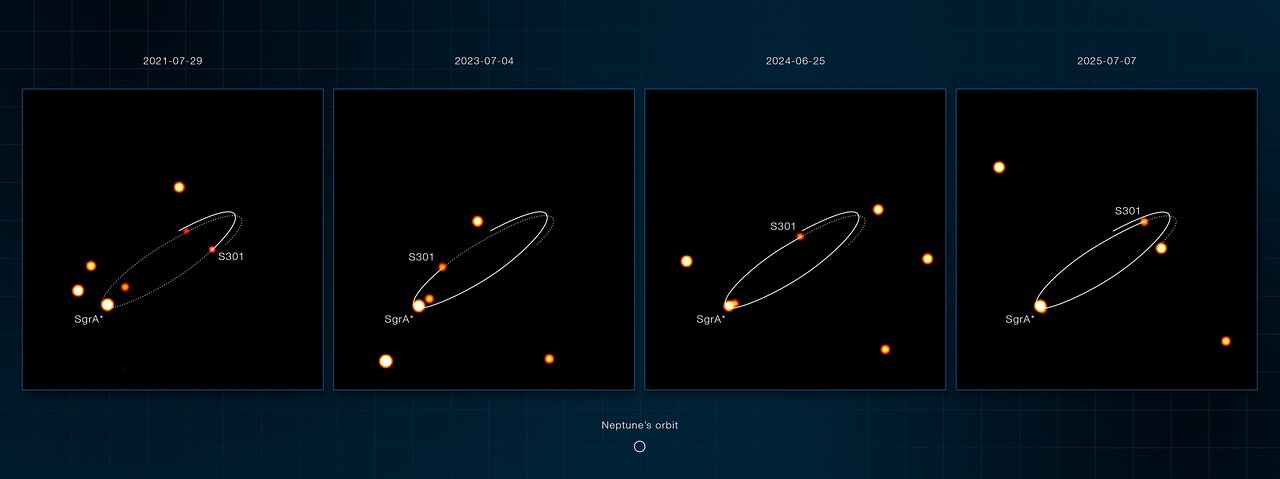
“这颗恒星的特殊之处在于,它在一条非常紧凑的轨道上绕人马A运行,仅需8.7年即可完成一周,且在最接近时刻(closest approach)时,距离仅为地球到太阳距离的12倍。这是前所未有的,”MPE博士生、今日发表于《自然》杂志的研究论文作者Felix Mang说道。
“What is special about this star is that it’s orbiting Sagittarius A* on a very tight orbit, taking just 8.7 years to complete it, and is approaching the black hole at a mere 12 times the distance of Earth to the Sun. That is unprecedented,” says Felix Mang, PhD student at MPE and author of the study published today in Nature.
在最接近黑洞的过程中,这颗恒星的运行速度约为每秒25 000公里——是商用飞机的100 000倍,或超过光速(speed of light)的8%——这使其成为银河系最快恒星的纪录保持者。S301与人马A的距离也比迄今观测到的任何其他恒星都要近,接近黑洞时的距离大约相当于土星(Saturn)到太阳的距离。[1] 由于S301与人马A靠得如此之近,它是目前已知第一颗可用于直接测量黑洞自转的恒星。
During its closest passage to the black hole, the star travels at around 25 000 kilometres per second — 100 000 times faster than a commercial plane, or over 8% of the speed of light — making it the record holder for the fastest star in the Milky Way. S301 also comes closer to Sagittarius A* than any other star observed so far, approaching the black hole at around the distance of Saturn to the Sun. [1] Because S301 comes so close to Sagittarius A*, it is the first star known that could be used to directly measure the rotation of a black hole.
正如宇宙(universe)中的大多数事物一样,天文学家预测人马A也在自转。根据爱因斯坦的广义相对论(general theory of relativity),旋转的黑洞会拖拽并扭曲周围的时空,从而影响周围恒星的轨道。对于在快速旋转的黑洞附近运行的物体,这种效应感受得更为强烈。
Like most things in our Universe, astronomers predict that Sagittarius A* spins. According to Einstein’s general theory of relativity, a spinning black hole drags spacetime along with it and twists it, which impacts the orbits of surrounding stars. The effect is felt more strongly for objects orbiting fast-rotating black holes at close range.
“通过这颗恒星,我们希望在未来10年内测量出黑洞的自转,”Mang说。同样在这一新研究中发挥了主导作用的MPE研究员Stefan Gillessen补充道:“我们将首次能够非常直接地测量大质量黑洞(massive black hole)的自转,这将是对爱因斯坦理论的关键检验。”法国巴黎天文台(Observatoire de Paris)的天文学家Juan Osorno在研究中也发挥了关键作用,他补充说:“如果没有这颗恒星,我们需要再观测其他恒星几十年的运动,才能接近测量黑洞自转的目标。”
“With this star we hope to measure, within the next 10 years, the spin of the black hole," says Mang. MPE researcher Stefan Gillessen, who also had a leading role in the new study, adds: “For the first time, we would actually be able to measure very directly the spin of a massive black hole, which would be a key test of Einstein’s theory.” Juan Osorno, an astronomer at LIRA Observatoire de Paris–PSL, France, who also had a key role in the study adds: “Without this star, we would need to measure the motion of other stars for several more decades to get anywhere close to measuring the spin of the black hole.”
发现S301并非易事,它在天空中的亮度比参宿四(Betelgeuse,猎户座(Orion)中的橙色恒星)暗二十亿倍。研究团队使用了位于智利帕拉纳尔天文台(Paranal Observatory)的VLTI设施及其GRAVITY仪器,该仪器在基础设施升级后现被称为GRAVITY+。[2] VLTI的超能力在于它能够结合四台8米望远镜的光线,创造出一台空间分辨率(spatial resolution)相当于单台8米望远镜15倍的“虚拟”望远镜。
Finding S301, which appears two billion times fainter than Betelgeuse (the orange star in the constellation Orion) in the sky, was no easy feat. The team used the VLTI, a facility at ESO’s Paranal Observatory in Chile and its GRAVITY instrument, now known as GRAVITY+ following an infrastructure upgrade. [2] The VLTI’s superpower lies in its ability to combine the light from four 8-metre telescopes to create a ‘virtual’ telescope with 15 times the spatial resolution of a single 8-metre telescope.
“在全球范围内,帕拉纳尔是唯一能进行此类观测的地方,因为世界上没有其他天文台拥有四台可以作为干涉仪(interferometer)协同工作的8米望远镜,”合著者、GRAVITY+项目负责人(Principal Investigator)兼MPE所长Frank Eisenhauer说。
“Worldwide, Paranal is the only place where you can do this type of observations because no other observatory in the world has four 8-metre telescopes that can act together as an interferometer,” says co-author Frank Eisenhauer, GRAVITY+ Principal Investigator and Director at MPE.
借助GRAVITY,以及后来的GRAVITY+,研究团队在2023年春季首次瞥见了这颗新生星(new star),并从那时起一直对其进行随动(follow-up)观测以约束其轨道。他们还能将S301的轨道历史追溯到2017年,发现它上一次最接近中心黑洞是在2023年初。S301的轨道特性,以及恒星无法在大质量黑洞附近形成的事实,表明该恒星很可能曾是一个双星系统的一部分,后被人马A的引潮力(tidal force)撕裂。在此过程中,S301被黑洞的引力捕获,而其伴星(companion star)则以极高的速度被踢出,极有可能足以使其彻底离开银河系。
With GRAVITY, and later with GRAVITY+, the team managed to catch a first glimpse of the new star in spring 2023 and have followed it since to constrain its orbit. They could also trace S301’s orbital history back to 2017, finding that it last made its closest approach to the central black hole in early 2023. S301’s orbital properties, and the fact that stars cannot form so close to a massive black hole, indicate that the star was likely part of a binary pair that was torn apart by the tidal forces of Sagittarius A*. In the process, S301 became trapped by the black hole’s gravity while its companion star was kicked out with high velocity, most likely enough to leave the galaxy altogether.
随着S301在2031年进行下一次最接近,利用GRAVITY+以及欧南台即将推出的特大望远镜(Extremely Large Telescope, ELT)上的MICADO仪器进行随动观测,对于追踪其未来十年的路径至关重要。观测S301至少两个完整的轨道,使其轨迹能够以足够高的精度得到约束,从而使团队能够首次直接确定人马A的自转。“那将是梦想成真,”Mang说。
Follow-up observations with GRAVITY+, and with the MICADO instrument on ESO’s upcoming Extremely Large Telescope (ELT), will be crucial for tracing S301’s path over the next decade, as it makes its next closest passage in 2031. Observing at least two complete orbits of S301 allows its trajectory to be constrained with high enough precision to enable the team to directly determine the spin of Sagittarius A* for the first time. “That would be a dream come true,” says Mang.
注
Notes
[1] 在最接近时刻,该恒星距离黑洞仅17.8亿公里,约为日地距离的12倍,或仅比日土距离大20%。
[1] At its closest approach, the star passes just 1.78 billion km from the black hole, around 12 times the Sun-Earth distance or just 20% larger than the Sun-Saturn distance.
[2] 在利用不同的欧南台设施对银河系中心绕行恒星进行了数十年的测绘后,研究团队自2017年起一直将VLTI上的GRAVITY仪器用于此目的。过去几年中,该仪器和干涉仪进行了一系列名为GRAVITY+的逐步升级,使他们能够发现越来越暗的天体。
[2] Following decades mapping stars orbiting the Milky Way’s centre using different ESO facilities, the team has been using the GRAVITY instrument on the VLTI for this purpose since 2017. A series of upgrades to both the instrument and the interferometer, called GRAVITY+, has been implemented gradually over the last few years, and has allowed them to find increasingly fainter objects.