查看原文全部插图(6 幅)
内容提要
本文介绍了美国国家航天局(NASA)猎户座航天器的构造细节、乘员舱设计及各项关键系统。猎户座通过先进的生命保障、热防护及冗余航电系统,确保了宇航员在深空任务中的安全与高效运行。
原文全文译文
部件
Parts
猎户座航天器由 355,056 个独立部件构成:
- The Orion spacecraft is built using 355,056 individual parts:
41,858 个发射中止系统部件
- 41,858 launch abort system parts
209,544 个乘员舱部件
- 209,544 crew module parts
103,023 个服务舱部件
- 103,023 service module parts
631 个集成部件
- 631 integration parts
猎户座上使用了 77,150 种不同类型的部件。
- There are 77,150 different types of parts that are used on Orion.
乘员舱
Crew Module
从人体工程学角度来看,猎户座的设计旨在容纳 99% 的人类群体,这一范围超过了美国国家航天局(NASA)过去、现在或未来的任何项目。该航天器可容纳身高在 4 英尺 10 英寸的女性至 6 英尺 5 英寸的男性之间的宇航员。
- From an anthropomorphic standpoint, Orion is designed to accommodate 99 percent of the human population, which is a larger range than every other NASA project past, present, or future. The spacecraft can accommodate astronauts as small as a 4-foot-10-inch tall female and as tall as a 6-foot-5-inch male.
猎户座的乘员舱提供的立方体积比阿波罗(Apollo)飞船多出约 60%。
- Orion’s crew module provides about 60 percent more cubic volume of space than the Apollo capsule.
在前往低月球轨道(lunar orbit)的初始任务中,猎户座可支持 4 名乘员在轨道上停留长达 21 天。前往更远目的地的任务可能仅搭载 2 名乘员,以便为机载消耗品留出更多空间。
- Orion can sustain a crew of four for up to 21 days in orbit during its initial missions to low lunar orbit. Missions to more distant destinations may have a crew of 2 to allow more room for consumables onboard.
猎户座可以在没有任何乘员的情况下,在月球轨道上自主运行超过六个月。
- Orion can orbit the Moon autonomously without any crew onboard for over six months.
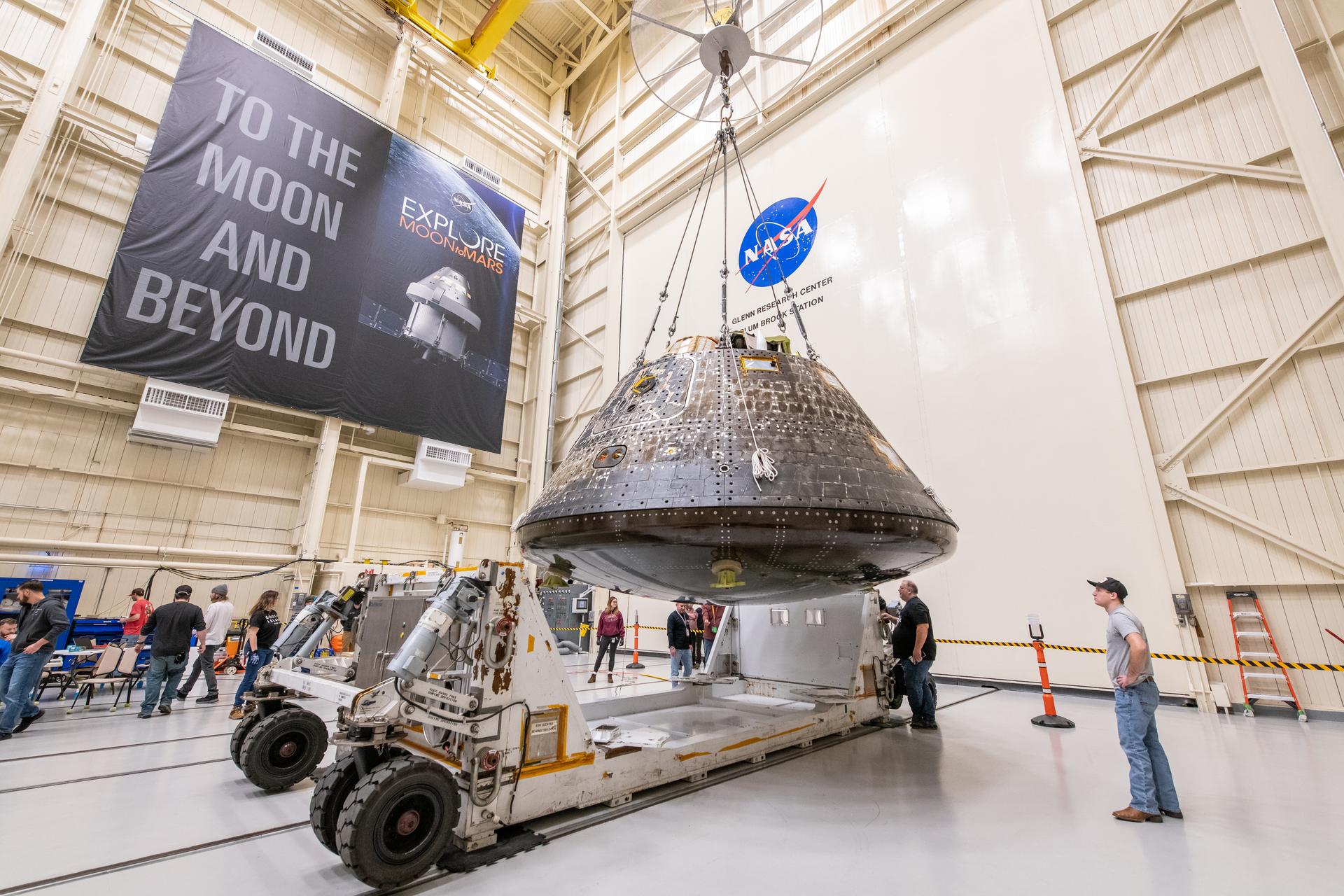
图注:NASA/Jordan Salkin
NASA/Jordan Salkin
服务舱
Service Module
欧洲服务舱由超过 20,000 个部件和组件组成,它们必须完美契合并可靠运行。
- The European Service Module is comprised of more than 20,000 parts and components that must fit together perfectly and perform reliably.
猎户座服务舱内的计算机控制着 33 台发动机,并读取超过 100 个压力和温度传感器的数据。
- The computer in Orion’s service module controls 33 engines and reads over 100 pressure and temperature sensors.
猎户座的四个太阳能电池阵列翼中的每一个都由三块面板组成,其产生的电力足以供两栋三居室住宅使用。
- Each of Orion’s four solar array wings are made of three panels that provide enough electricity to power two three-bedroom homes.
在太空中,猎户座的轨道机动系统发动机(OMS-e)可产生 6,000 磅(即 26.7 kN)的推力。在地球上,如果你将一台 OMS-e 绑在汽车上,它可以在约 2.7 秒内从 0 加速到 60 英里/小时,跻身世界十大最快量产车之列。
- In space, Orion’s orbital maneuvering system engine, called the OMS-e, produces 6,000 pounds, or 26.7 kN, of thrust. Here on Earth, if you were to strap an OMS-e to a car, it would accelerate from 0-60 mph in approximately 2.7 seconds, ranking it among the world’s top 10 fastest production cars.
用于阿耳忒弥斯 2 号(Artemis II)的猎户座服务舱主发动机曾随航天飞机(space shuttle)亚特兰蒂斯号(Atlantis)六次进入太空。
- Orion’s service module main engine for Artemis II has been to space 6 times on the Atlantis Space Shuttle.
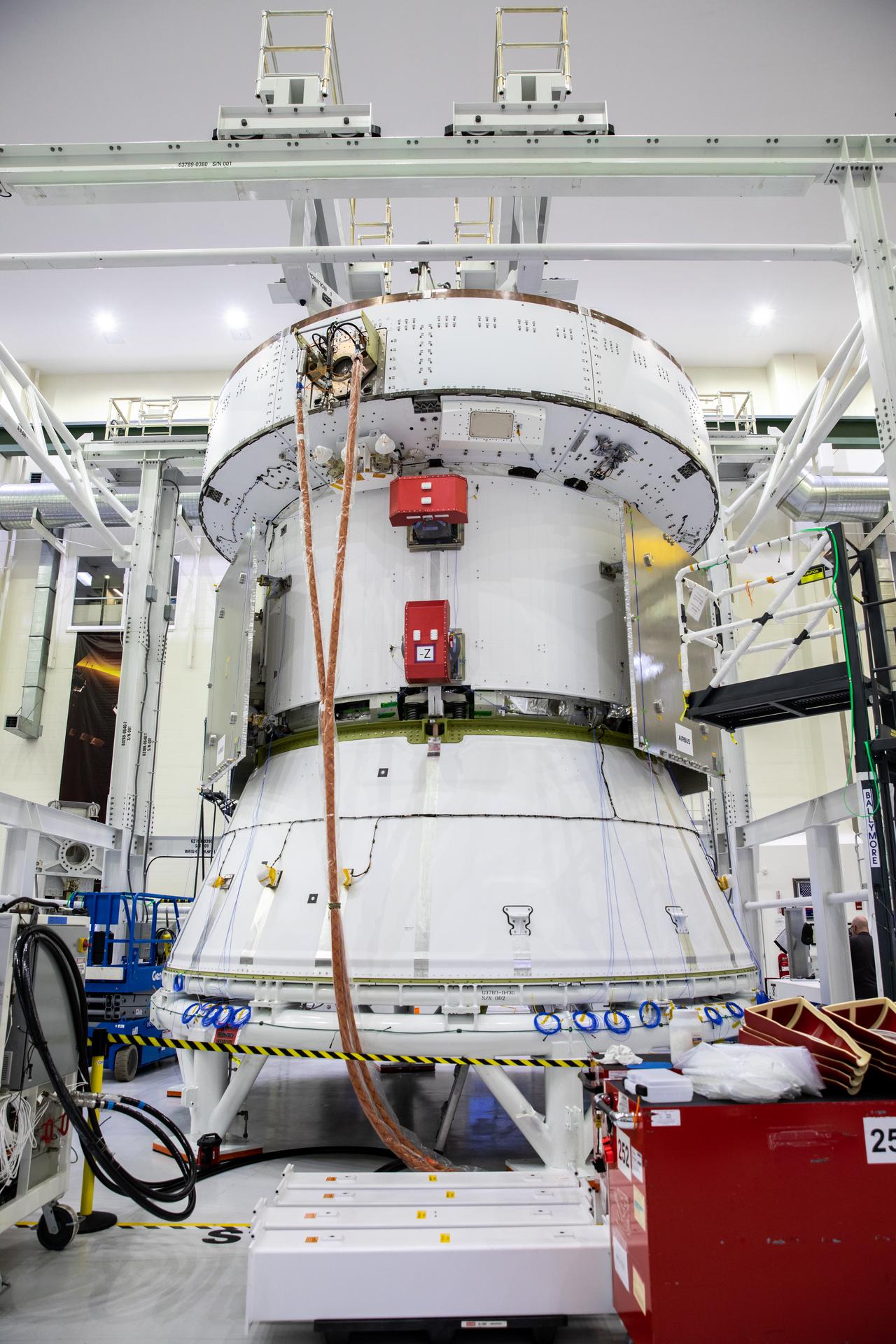
图注:NASA/Kim Shiflett
NASA/Kim Shiflett
发射中止系统
Launch Abort System
猎户座发射中止系统(LAS)上的中止发动机可在几毫秒内产生 400,000 磅的推力,迅速将乘员舱推离危险区域。
- The abort motor on Orion’s launch abort system (LAS) generates 400,000 pounds of thrust in a matter of milliseconds to quickly propel the crew module away from danger.
在发射台(launch pad)中止情况下,猎户座的发射中止系统可在 2 秒内从 0 加速到 500 英里/小时。
- From a launch pad abort, Orion’s launch abort system accelerates from 0 to 500 mph in 2 seconds.
LAS 固体火箭发动机使用的推进剂燃烧温度为 4,456°F,接近太阳表面温度的一半。虽然该温度足以熔化钢铁,但发动机内部的特殊隔热层能极好地保护钢壳,使外壳表面温度仅达到约 130°F,从而保持乘员舱内部凉爽。
- The LAS solid rocket motors use propellant that burns at a temperature of 4,456°F, nearly half the temperature on the surface of the Sun. While that temperature is hot enough to boil steel, special insulation inside the motor protects the steel case so well that the outside of the case reaches only about 130°F and the crew cabin remains cool.
LAS 的发动机使用的推进剂是一种类似橡胶的固体燃料和氧化剂混合物,其质地如同硬橡胶橡皮擦。
- The motors of the LAS use a propellant is a solid rubberlike substance of fuel and oxidizer that has the consistency of a hard rubber eraser.
从中止发动机喷管排出的燃烧气体速度为 2,600 英里/小时,超过声速(speed of sound)的 3 倍,是步枪子弹速度的 2 倍。
- Combustion gases exiting the abort motor nozzles travel at a speed of 2,600 mph, more than 3 times the speed of sound and 2 times the speed of a bullet shot from a rifle.
如果将中止发动机的能量转化为电能,足以供 13,000 户家庭使用一整天。
- If the abort motor energy could be converted to electric power, it would be enough to power 13,000 houses for an entire day.
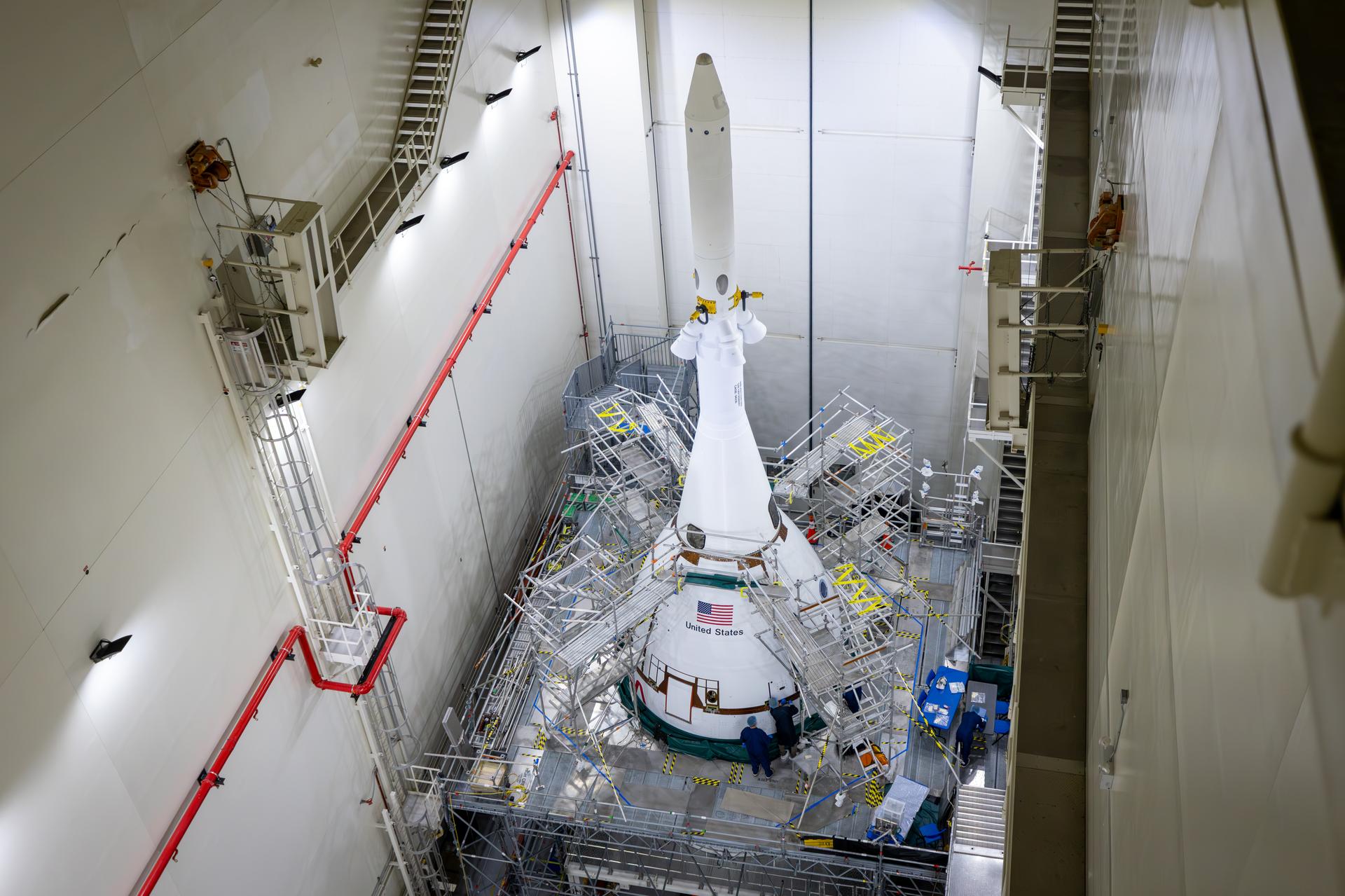
图注:NASA/ Frank Michaux
NASA/ Frank Michaux
航电系统
Avionics
猎户座 S 波段通信系统集成了 4 台无线电的功能,可实现与以下系统的通信:多个航天器(space vehicle)、NASA 近地空间网络直接对地服务、NASA 数据转播卫星(data-relay satellite)服务、NASA 深空探测网(Deep Space Network)以及这些系统的任意组合。
- The Orion S-Band communications system provides functionality of 4 radios in one, allowing communication with: multiple space vehicles, NASA’s Near Space Network Direct-To-Earth Services, NASA’s Tracking and Data Relay Satellite (TDRS) Services, NASA’s Deep Space Network (DSN), and any combination of these systems.
猎户座提供了完全冗余的乘员控制和显示系统,包含超过 60 种图形用户界面(GUI)格式和交互式电子程序——这在航天器历史上尚属首次。宇航员无需依赖分布在庞大飞行甲板上的物理开关,而是可以通过 GUI 上显示的“虚拟”开关,在单一操作台控制所有航天器系统。
- Orion provides fully redundant crew controls and displays with over 60 graphical user interface, or GUI formats and interactive electronic procedures – a first in spacecraft history. Instead of relying on physical switches distributed across a vast flight deck, astronauts can control all of the vehicle systems from a single operator station using ‘virtual’ switches displayed on GUIs.
与阿波罗的单台飞行计算机相比,猎户座拥有两台同时运行的冗余飞行计算机。每台计算机包含两个冗余模块,总计拥有四个冗余系统。
- Compared to Apollo’s single flight computer, Orion has two simultaneously operating redundant flight computers. Each of these includes two redundant computer modules, giving it a total of four redundant systems.
猎户座的两台冗余计算机中,单台的重量仅为阿波罗飞船上唯一计算机的四分之三,但内存容量增加了 128,000 倍,速度提升了 20,000 倍。
- One of Orion’s two redundant computers is only three quarters the weight of the sole computer aboard Apollo, has 128,000 times more memory and is 20,000 times faster.
隔热罩
Heat Shield
在从月球任务返回地球的过程中,猎户座及其隔热罩必须保护航天器和乘员免受高达约 5,000°F 的外部温度影响。
- During return to Earth from a mission to the Moon, Orion and its heat shield must protect the vehicle and crew from external temperatures up to around 5,000°F.
5,000°F 高于钛的熔点(约 3,000°F)。这也约为太阳表面温度(约 10,000°F)的一半。
- 5,000°F is hotter than the melting point for titanium, which is about 3,000°F. It’s also about half the surface temperature of the Sun, which is about 10,000°F.
虽然进入地球大气层时的外部温度将达到 5,000°F,但航天器内部温度将保持在 70 多华氏度——外部如同熔岩般炽热,内部却凉爽舒适。
- While the outside temperatures during entry into Earth’s atmosphere will reach 5,000°F, inside the spacecraft it will be in the mid-70s – hotter than molten lava on the outside and cool as a cucumber on the inside.
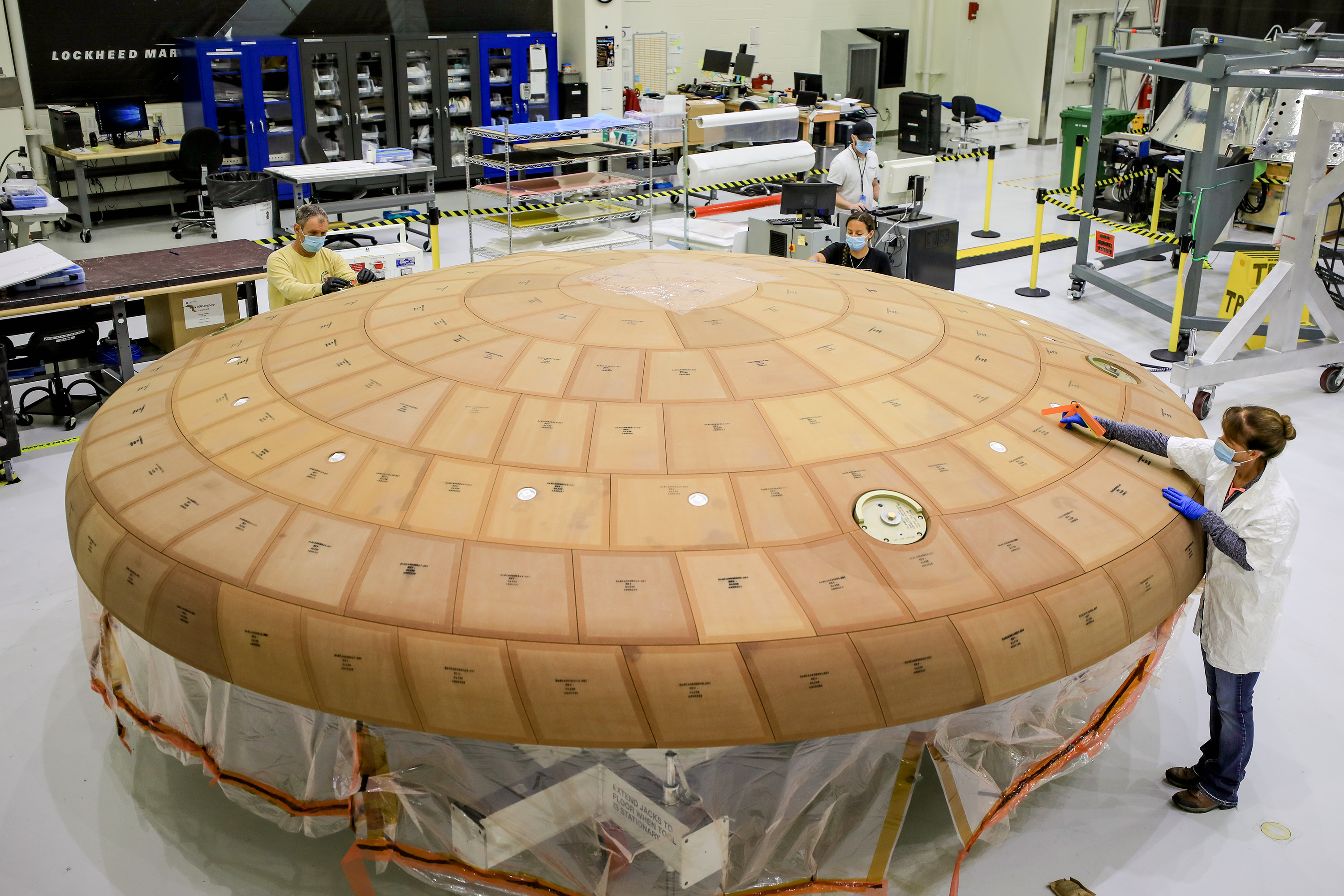
乘员舱底部的隔热罩宽 16.5 英尺。它是世界上最大型的烧蚀隔热罩。猎户座的热防护系统是航天器最重要的部件之一,负责在返回过程中保护宇航员。
- The heat shield on the bottom of the crew module is 16.5 feet wide. It is the largest ablative heat shield in the world. Orion’s thermal protection system is one of the most important parts of the spacecraft and is responsible for protecting the astronauts during their return.
图注:NASA
NASA
生命保障与安全
Life Support and Safety
猎户座的闭环生命保障(life support)系统能够在压力容器泄漏或舱内大气受污染的情况下,为穿着宇航服的乘员维持长达 144 小时的正压、可呼吸大气和热冷却环境。
- Orion’s closed loop life support system is capable of maintaining a positive pressure, breathable atmosphere, and thermal cooling for up to 144 hours to suited crewmembers in the event of a pressure vessel leak or contaminated cabin atmosphere.
猎户座的设计旨在确保在任务的任何阶段,无论与地球的轨道对齐情况如何,都能执行中止并返回地球,并为着陆后的机组人员提供长达 24 小时的安全避难所和生存装备。
- Orion is designed to execute an abort and return to Earth from any point in the mission regardless of orbital alignment with Earth, and provides a safe haven and survival equipment for onboard crew for up to 24 hours post-landing.
猎户座旨在通过集成备份飞行计算机、生命保障系统手控(manual control)、通信和导航辅助设备,在发生多重星系(multiple system)故障时确保乘员安全返回。
- Orion is designed to provide assured crew return in the event of multiple system failures incorporating a backup flight computer, manual control of life support systems, communication, and navigation aids.
致力于猎户座乘员舱设计的 NASA 和洛克希德·马丁公司工程师,与专门研究碰撞伤害的纳斯卡(NASCAR)和印地赛车(Indy Car)专家合作,设计了最先进的乘员座椅、约束装置和冲击衰减机制,以防止宇航员在硬着陆时受伤。
- NASA and Lockheed Martin engineers working on the design of the Orion crew module collaborated with NASCAR and Indy Car racing experts specializing in crash injuries to design state-of-the art crew seats, restraints, and impact attenuation mechanisms to prevent injury of the astronauts in the event of a hard landing.
降落伞
Parachutes
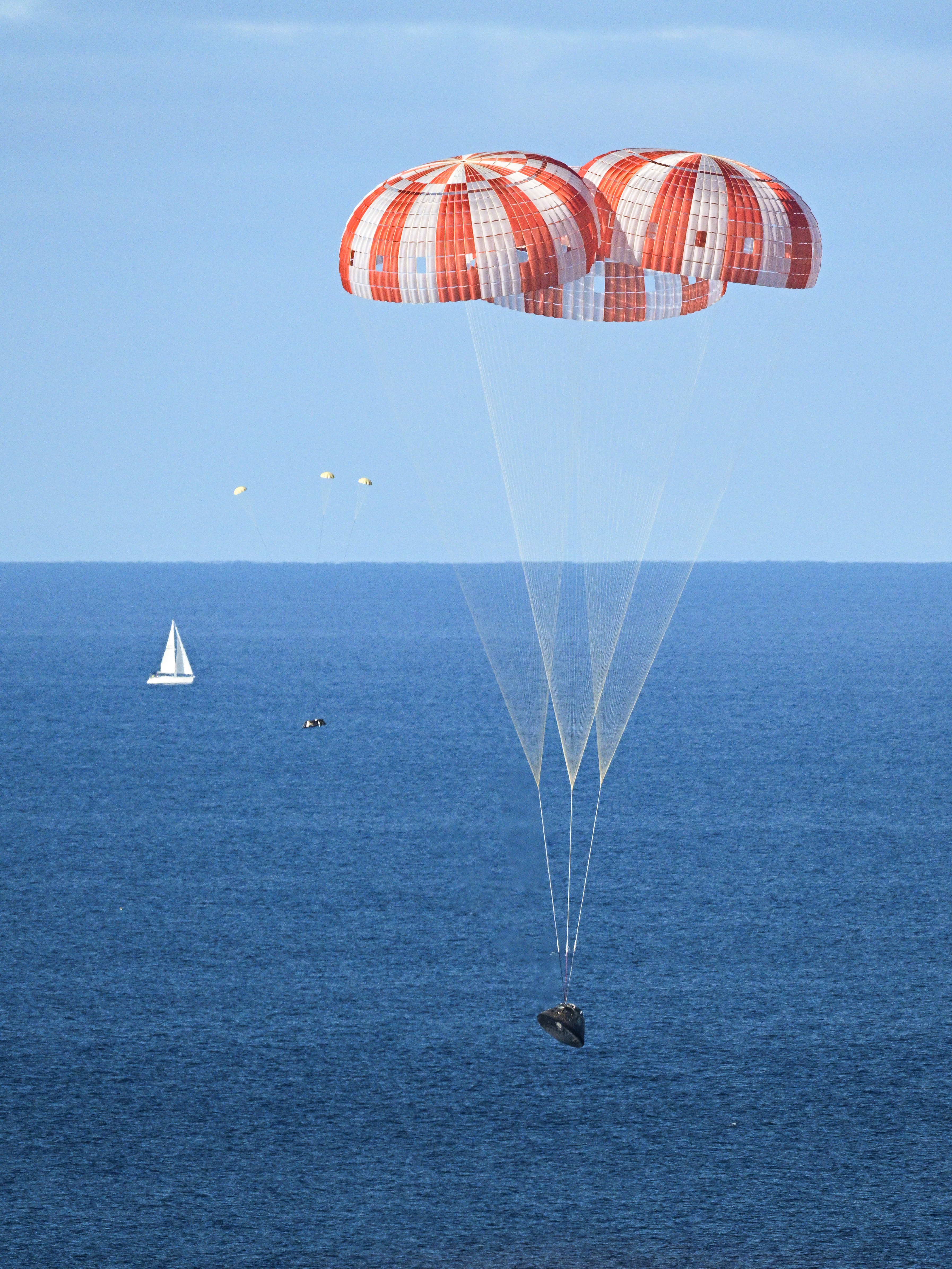
在进入大气层期间,地球(Earth)的大气层将猎户座(Orion)的速度从 25,000 mph 减慢至约 325 mph,但降落伞会将速度进一步降低至约 17 mph,以便在海洋中平稳溅落。
- The Earth’s atmosphere slows Orion down from 25,000 mph to about 325 mph during entry, but parachutes will slow it down the rest of the way to about 17 mph for a gentle splashdown in the ocean.
降落伞系统总共包含 11 个降落伞,它们必须协同工作。
- The parachute system has a total of 11 parachutes, and they all have to work carefully together.
其中包括 3 个 7 英尺的前舱盖降落伞,用于移除前舱盖;2 个 23 英尺的减速伞,用于减慢并稳定乘员舱(crew module);以及 3 个 11 英尺的引导伞,用于辅助部署 3 个 116 英尺的主降落伞。
- There are three 7 ft. forward bay cover parachutes that remove the forward bay cover, two 23 ft. drogue parachutes that slow and stabilize the crew module and three 11 ft. pilot parachutes that help to deploy the three 116 ft. main parachutes.
这 3 个主降落伞展开后的总直径足以覆盖一个橄榄球场从 10 码线到 10 码线的区域。
- The diameter of the three main parachutes combined would cover a football field from 10-yard line to 10-yard line.
每个主降落伞有 80 根悬挂绳。每根悬挂绳的额定承重至少为 1,500 磅,足以支撑 6 名成年人并留有余量。3 个主降落伞的悬挂绳总长度约为 10 英里。
- Each main parachute has 80 suspension lines. Each suspension line is rated to carry at least 1,500 lbs., which is strong enough to hold 6 adults with some margin to spare. » The suspension lines on the three main parachutes combined are approximately 10 miles total length.
主降落伞使用液压机进行打包,施加的力高达 50,000 磅。它们的密度约为每立方英尺 44 磅,这与橡木的密度大致相同(远高于松木的密度)。
- The main parachutes are packed using a hydraulic press, using forces as high as 50,000 lbs. Their density is approximately 44 lbs. per cubic foot, which is roughly the same density as oak (and a much higher density than pine).
图注:(NASA/Josh Valcarcel)
(NASA/Josh Valcarcel)
来源与许可
原文来自公共领域来源;译文由机器生成,请以原文为准。 原始页面