内容提要
美国国家航天局(NASA)/欧洲航天局(ESA)的哈勃空间望远镜在土星南半球(southern hemisphere)发现了一个巨大的十边形大气波。这一发现标志着科学家首次在土星南半球观测到此类规则的急流(jet stream)模式,并为研究巨行星(giant planet)的大气演化提供了难得的机会。
原文全文译文
heic2612 — 科学发布
heic2612 — Science Release
哈勃空间望远镜追踪到环绕土星南极的新十边形结构
Hubble tracks new decagon encircling Saturn’s south pole
2026年9月2日
2 September 2026
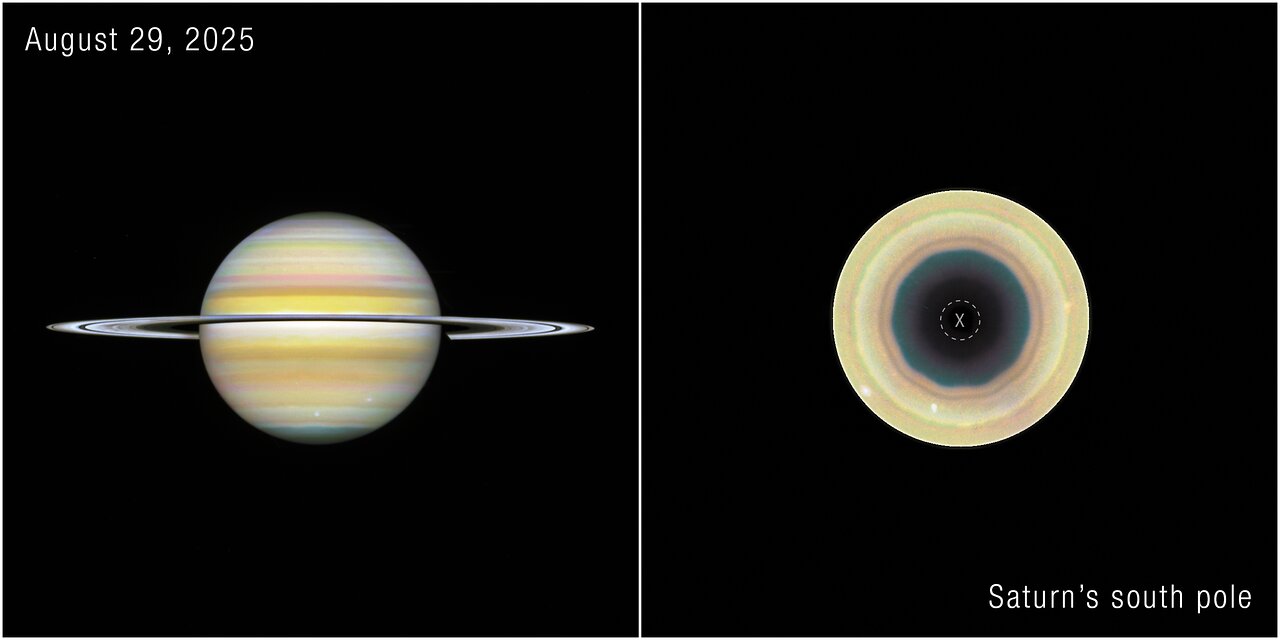
近期,利用美国国家航天局(NASA)/欧洲航天局(ESA)哈勃空间望远镜(Hubble Space Telescope)进行的观测,揭示了一个环绕土星(Saturn)南极(south pole)的巨大且不断演化的十边形大气波。这一发现标志着科学家首次在土星南半球(southern hemisphere)观测到大型规则边数的急流(jet stream)模式。该特征与土星北极著名的六边形惊人地相似,但又有着明显的不同,这表明科学家可能正在见证这一标志性气态巨行星上出现的一种全新大气现象。
Recent observations with the NASA/ESA Hubble Space Telescope have revealed a giant, evolving 10-sided atmospheric wave encircling Saturn’s south pole. This discovery marks the first time a large regular-sided jet pattern has been observed in the planet’s southern hemisphere. The feature appears remarkably similar to Saturn’s famous hexagon at its northern pole, but is also distinctly different, suggesting scientists may be witnessing a new atmospheric phenomenon develop on the iconic gas giant.
通过整合自2023年以来的多年哈勃观测数据,研究人员在这一结构形成清晰的模式之前,就发现了其开始显现的细微迹象。这些观测是哈勃“外行星大气遗产”(OPAL)项目的一部分,该项目十多年来每年都会对带外行星(outer planet)进行拍摄。
By piecing together several years of Hubble observations dating back to 2023, researchers found subtle hints of the structure beginning to emerge before it became a clearly defined pattern. Those observations were taken as part of Hubble’s Outer Planet Atmospheres Legacy (OPAL) program, which has photographed the outer planets annually for more than a decade.
研究结果已发表在《科学进展》(Science Advances)期刊上。
The results have been published in the journal Science Advances.
“在土星南半球,我们从未见过类似的东西,”该研究的合著者、美国国家航天局(NASA)戈达德航天中心(Goddard Space Flight Center)的OPAL首席研究员Amy Simon表示,“北极的六边形在我们过去40多年的观测中一直存在。而这个特征则不同——它似乎正在增强,这为我们提供了一个难得的机会,去观察一个巨大的大气模式是如何形成的。”
“We’ve never seen anything quite like this in Saturn’s southern hemisphere,” said Amy Simon, study co-author and OPAL principal investigator, NASA’s Goddard Space Flight Center in Greenbelt, Maryland. “The northern hexagon has been there every time we’ve looked for more than 40 years. This feature is different — it appears to be strengthening, giving us the rare opportunity to watch a giant atmospheric pattern develop.”
这一发现之所以成为可能,是因为土星季节的变化逐渐使土星南极重新进入地球(Earth)的观测视野,而那些通过地基天文台(ground-based observatory)分析土星图像的敏锐天文学家(astronomer)们率先识别出了它。
The discovery was possible because Saturn’s changing seasons gradually brought the planet’s south pole back into view from Earth, where keen-eyed astronomers who collectively analyse images of Saturn from ground-based observatories first identified it.
该项新研究的首席作者Agustín Sánchez-Lavega是西班牙巴斯克大学的研究员。该大学管理着一个名为“行星虚拟天文台实验室”(Planetary Virtual Observatory Laboratory)的网站,接收来自世界各地观测者提供的太阳系(solar system)行星地基图像。正是通过这些图像,Sánchez-Lavega与天文爱好者(amateur astronomer)Trevor Barry和Jean-Paul Oger在2024年首次注意到南极沿线存在一条细微的起伏带。2025年从地面拍摄的额外图像进一步强烈暗示了这一十边形结构的存在。
Agustín Sánchez-Lavega, lead author of the new study, is a researcher at the University of the Basque Country in Spain. The university manages a website, called Planetary Virtual Observatory Laboratory, that accepts ground-based images of Solar System planets contributed by observers all over the world. It was in those images, first in 2024, that Sánchez-Lavega and amateur astronomers Trevor Barry and Jean-Paul Oger noticed a subtle undulating band along the southern pole. Additional 2025 imagery taken from the ground hinted even more strongly toward this decagon structure.
这时,哈勃的观测发挥了作用。哈勃从太空的观测视角提供了无与伦比的图像清晰度和空间分辨率(spatial resolution),能够覆盖土星的完整自转周期,且不会受到地球大气层的干扰。
That’s when the Hubble observations come into the picture. Hubble’s vantage from space offers unmatched image sharpness and spatial resolution over full rotations of Saturn, without smearing by Earth’s atmosphere.
“考虑到土星南北急流系统的对称性,自1990年以来,我们一直在哈勃图像中寻找土星北极六边形在南极的对应物,”Sánchez-Lavega说,“卡西尼号土星探测器(Cassini spacecraft)在2004年至2017年间环绕土星飞行,其图像也没有显示出任何长寿命结构的迹象。哈勃数据证实了该特征早在2023年就已存在。”
“Given Saturn’s symmetry in its north-south jet stream system, we have been searching for a counterpart to Saturn’s northern hexagon on the south pole in Hubble images since 1990,” Sánchez-Lavega said. “Images from the Cassini spacecraft, which orbited Saturn between 2004 and 2017, showed no inkling of a long-lived formation, either. The Hubble data confirmed the feature’s presence back to 2023.”
该波位于土星强大的急流之一内,并延伸穿过大气的多个层级,这表明它不仅仅是一个云层特征,而是一个垂直延伸的大气结构。由于哈勃在不同波长下拍摄图像,十边形的视位置(apparent position)会略有偏移。这些不同的波长探测的是土星大气中不同的高度。
The wave sits within one of Saturn’s powerful jet streams and extends through multiple layers of the atmosphere, indicating it is not just a cloud-level feature, but a vertically extended atmospheric structure. The decagon’s apparent position shifts slightly, because Hubble captures images from different wavelengths. Those different wavelengths probe different altitudes in Saturn’s atmosphere.
“对我来说,最引人入胜的部分是它似乎是最近才形成的,”Simon说,“问题在于,为什么我们以前从未见过,而它现在却突然形成了?”
“The most intriguing part to me is that this seems to have just formed recently,” said Simon. “The question is, why did it suddenly form now when we haven’t seen one before?”
未来需要利用哈勃和美国国家航天局(NASA)/欧洲航天局(ESA)/加拿大航天局(CSA)的韦布空间望远镜(James Webb Space Telescope)进行进一步研究,并结合计算机模型(computer model)分析,以了解该十边形是如何形成的、它可能持续多久,以及它与北极长寿命六边形的对比情况。
Further study is needed from Hubble and the NASA/ESA/CSA James Webb Space Telescope, as well as analysis of computer models, to understand how the decagon formed, how long it may last, and how it compares to the long-lived hexagon in the north.
这一发现凸显了哈勃最大的优势之一:其长期的运行时间使天文学家能够追踪太阳系行星及其他天体(astronomical object)随时间发生的变化。
The discovery highlights one of Hubble’s greatest strengths: its long duration in operation has allowed astronomers to track changes over time in Solar System planets and other astronomical objects as well.
OPAL项目不仅提供单一的快照,还允许科学家追踪季节性变化、监测短寿命风暴,并识别其他随时间缓慢演化的大气特征。
Rather than providing a single snapshot, the OPAL program allows scientists to follow seasonal changes, track short-lived storms, and identify other atmospheric features that evolve slowly over time.
“当我们启动OPAL项目时,我们期待着引人注目的惊喜,但我们并不知道具体会期待什么,”该研究合著者、加州大学伯克利分校的Mike Wong说,“我们从OPAL中看到的许多发现,不仅仅基于单次观测,而是基于多年积累的数据。长期的常规观测(regular observation)正在促成许多新的发现。”
“When we started the OPAL program, we expected compelling surprises but we didn’t know what to expect specifically,” said Mike Wong, study co-author, University of California, Berkeley. “A lot of the discoveries we see coming from OPAL are not just based on one observation, but on years and years of data. Regular observations over time are enabling a lot of new findings.”
研究团队计划继续观测土星,以确定该十边形是会像北极六边形那样演变成一个长寿命、稳定的结构,还是会继续演变。未来的观测也有助于科学家确定是什么驱动了这种波,它揭示了整个太阳系巨行星(giant planet)的大气动力学,以及它们与我们在地球上所见现象之间的联系。
The team plans to continue observing Saturn to determine whether the decagon settles into a long-lived, stable configuration like the northern hexagon or continues to evolve. Future observations also could help scientists determine what drives the wave, what it reveals about the atmospheric dynamics of giant planets throughout the Solar System, and how they may relate to those we see here on Earth.