内容提要
来自夏威夷的学生为双子座北望远镜(Gemini North telescope)拍摄的相互作用星系NGC 7253命名。该项目旨在通过Hōkūlani计划,让当地学生参与天文学研究并深入了解Maunakea的科学与文化意义。
原文全文译文
夏威夷学生为闪耀的星系对“Nā ʻUhane Māhoe Huki Pū i ke Ola”命名
Hawai‘i Students Name Image of Glittering Galaxy Pair Nā ʻUhane Māhoe Huki Pū i ke Ola
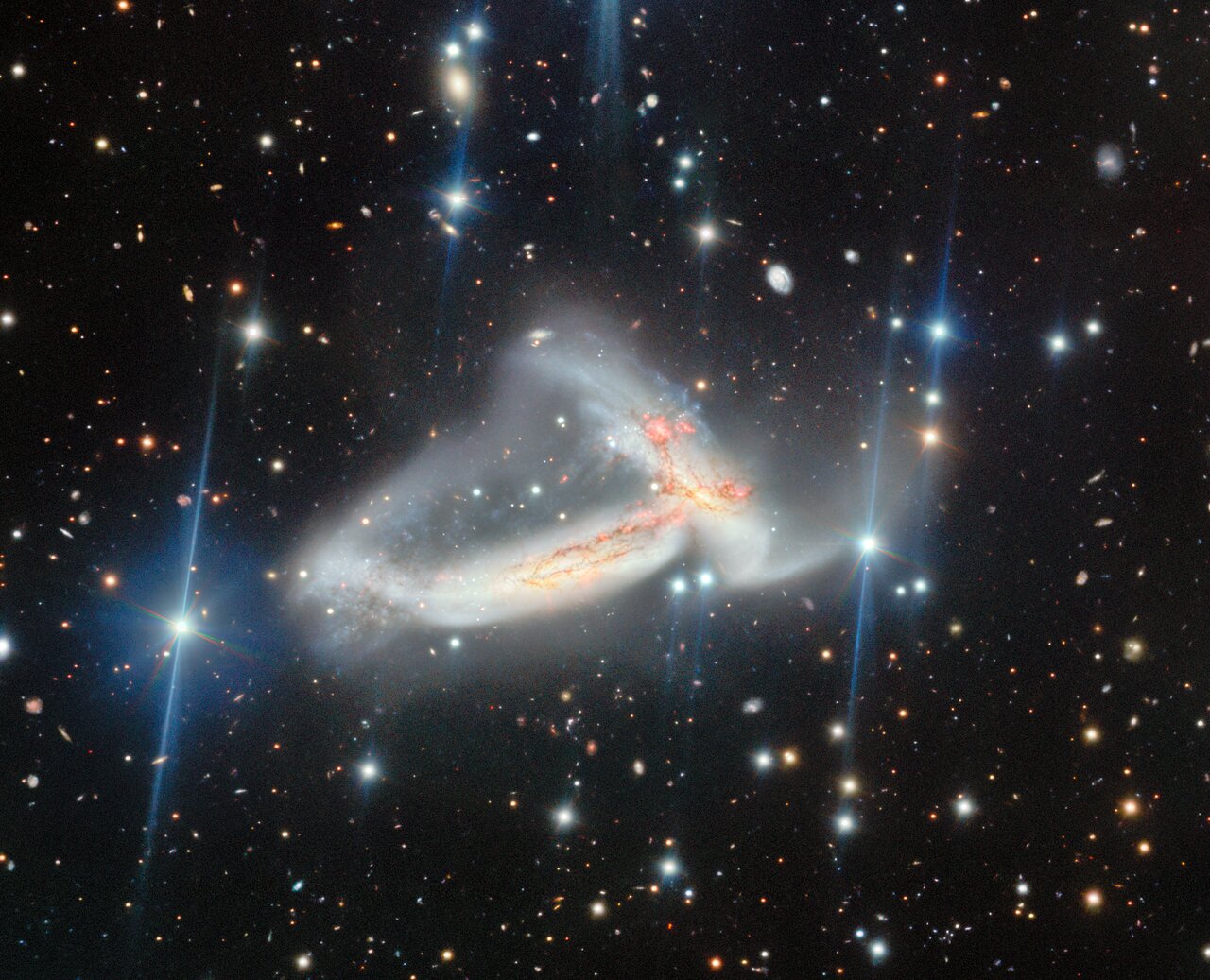
Hōkūlani计划的实习生研究并命名了这张由双子座北望远镜(Gemini North telescope)拍摄的全新图像,图中展示了被称为NGC 7253的迷人相互作用星系(interacting galaxy)对。
Project Hōkūlani interns researched and named this new Gemini North image featuring the stunning pair of interacting galaxies known as NGC 7253
2026年9月1日
1 September 2026
“Nā ʻUhane Māhoe Huki Pū i ke Ola”是夏威夷语,被赋予了这张NGC 7253的图像——这是一对受彼此引力影响的旋涡星系(spiral galaxy)。这张由位于夏威夷Maunakea的双子座北望远镜拍摄的图像,为今年参加Hōkūlani计划的实习生们创造了一次壮观的象征性展示。
Nā ʻUhane Māhoe Huki Pū i ke Ola is the Hawaiian name given to this image of NGC 7253 — a pair of spiral galaxies caught in each other’s gravity. Captured by the Gemini North telescope on Maunakea in Hawai‘i, this image created a spectacular symbolic display for this year’s interns participating in Project Hōkūlani.
在距离地球超过2亿光年(light year)的Ka Lupe o Kawelo(飞马座,Pegasus)深处,坐落着NGC 7253,这是一对相距约400万光年的引力相互作用星系。这一闪耀的相遇景象由双子座北望远镜拍摄,该望远镜是国际双子座天文台(International Gemini Observatory)的一部分,由美国国家科学基金会(National Science Foundation,NSF)部分资助,并由NSF美国国家光学红外天文研究实验室(NOIRLab)运营。这张新图像为观众提供了迄今为止对NGC 7253最清晰的观察视角,并被命名为“Nā ʻUhane Māhoe Huki Pū i ke Ola”,意为“双生之灵合力创造生命”。
Over 200 million light years away, deep within the constellation Ka Lupe o Kawelo (Pegasus), is NGC 7253 — a pair of gravitationally interacting galaxies separated by a distance of about four million light years. This glittering view of their meeting was captured by the Gemini North telescope, one half of the International Gemini Observatory, partly funded by the U.S. National Science Foundation (NSF) and operated by NSF NOIRLab. The new image offers viewers the closest look yet at NGC 7253, and has been named Nā ʻUhane Māhoe Huki Pū i ke Ola, which translates to “The Twin Spirits Pulling Together Creating Life.”
这张图像的创作始于2025年10月,来自Waiākea高中以及Volcano艺术与科学学校的三名当地学生参加了Hōkūlani实习计划。实习生Raiyan Rahman、Rafan Rahman和Alia Tamanha在双子座北望远镜希洛基地设施度过了一周,目标有三:了解天文台(Observatory)的运作及科学数据的收集方式;加深对Maunakea的认识;并为双子座北望远镜选择一个天体(astronomical object)进行成像。
The creation of this image began in October 2025 with three local students from Waiākea High School and the Volcano School of Arts and Sciences participating in the Project Hōkūlani internship. Interns Raiyan Rahman, Rafan Rahman, and Alia Tamanha spent one week at the Gemini North Hilo Base Facility with three goals: learn about observatory operations and how scientific data is collected; deepen their own appreciation for Maunakea; and select an astronomical object for Gemini North to image.
“NGC 7253是一个迷人的天体,因为它是两个在数十亿年间并合(galaxy merger)为一个星系的星系。但我们选择它主要是因为它是在夏威夷星座(constellation)Ka Lupe o Kawelo中为数不多的天体之一,”Raiyan Rahman说。“在Maunakea度过这么多时间后,选择一个在文化和天文学(astronomy)上都具有重要意义的对象对我们来说非常重要。”
“NGC 7253 is a fascinating object because it’s two galaxies that are merging into one over billions of years. But we mainly picked this object because it was one of the few that actually lay within a Hawaiian constellation, Ka Lupe o Kawelo,” says Raiyan Rahman. “After spending so much time on Maunakea, it was important to us to pick something that was both culturally and astronomically significant.”
2026年6月,来自Keaʻau高中和Kamehameha学校的三名当地学生加入了Hōkūlani实习项目。Mylin Wilson、Manu Silva-Sampaio和Samantha Silva-Sampaio分享了与前任实习生相同的目标,并在此基础上为NGC 7253的新图像命名。
In June 2026, three more local students from Keaʻau High School and Kamehameha Schools joined the Project Hōkūlani internship program. Mylin Wilson, Manu Silva-Sampaio, and Samantha Silva-Sampaio shared many of the same goals as their predecessors, and built upon their work by creating a name for the new image of NGC 7253.
所选名称“Nā ʻUhane Māhoe Huki Pū i ke Ola”的灵感来源于相互作用星系的双重性质,并象征着学生们在暑期实习期间经历的变革性体验。名称的每一部分都对应着实习生经历的不同侧面。
The chosen name, Nā ʻUhane Māhoe Huki Pū i ke Ola, is inspired by the dual nature of the interacting galaxies and symbolizes the transformative experience the students had during their summer internship. Each portion of the name corresponds to a different part of the interns’ experience.
“Nā ʻUhane Māhoe”代表了两个大小相似的星系及其纤细的旋臂(spiral arm)。它也代表了国际双子座天文台的双重性质,即由位于夏威夷的双子座北望远镜和位于智利Cerro Pachón的双子座南望远镜组成。
Nā ʻUhane Māhoe represents the two similarly sized galaxies and their wispy spiral arms. It also represents the twin nature of the International Gemini Observatory, composed of the Gemini North telescope in Hawai‘i and the Gemini South telescope on Cerro Pachón in Chile.
“‘Uhane(灵魂)是我们小组的一个重要主题。我们在这一周的经历——‘oli(观星)、参观山顶,以及了解Maunakea带来的伟大科学发现——在我们准备高中毕业后的生活时点燃了我们的精神,”Samantha Silva-Sampaio说。
“ʻUhane (spirit) was an important theme for our group. Our experiences throughout the week — ʻoli (stargazing), visiting the summit, and learning about the awesome scientific discoveries made possible by Maunakea — ignited our own spirits as we prepare for life after high school,” says Samantha Silva-Sampaio.
“这张图像中的‘Uhane提醒我们,天文学不仅仅是科学或精神;它两者兼而有之,”Manu Silva-Sampaio补充道。
“ʻUhane in this image reminds us that astronomy is not just science or spirit; it's both at the same time,” adds Manu Silva-Sampaio.
“Huki Pū”代表了星系在彼此引力驱动下被拉在一起的物理和字面意义。它也代表了为使Hōkūlani计划成为现实而共同努力的社区。
Huki Pū represents the physical and literal aspect of the galaxies being pulled together, driven by the force of each other's gravity. It also represents the communities that came together to make Project Hōkūlani a reality.
“来自世界各地和不同专业领域的人们齐心协力使我们的实习成为可能,我们从每个人身上学到了很多,”Wilson说。“我们的经历,以及天文学本身,是一种kākou(集体)式的实践。”
“Many people from around the world and different areas of expertise came together to make our internship possible, and we learned so much from everyone,” says Wilson. “Our experience, and astronomy itself, is a kākou (collective) type of practice.”
最后,“i ke Ola”代表了相互作用星系所能创造的生命。为了给这张图像选择一个贴切的名字,实习生们研究了相互作用星系和并合星系。他们了解到,当旋涡星系开始并合时,其旋臂中的气体和尘埃会发生碰撞,导致恒星形成(star formation)的显著爆发。来自新诞生恒星的极热辐射会使周围的气体电离或激发。当原子氢被电离时,会形成所谓的H II区域,在图像中表现为明亮的粉色光团。Manu Silva-Sampaio说:“恒星是我们人类生命和健康的源泉,因为我们的太阳就是一颗恒星,没有它我们就无法生存。”
Finally, i ke Ola represents the life that can be created by interacting galaxies. To choose a fitting name for this image, the interns researched interacting galaxies and galaxy mergers. They learned that when spiral galaxies begin to merge, the gas and dust in their spiral arms collide, causing a significant burst in star formation. Extremely hot radiation from the newly born stars ionizes, or energizes, the surrounding gas. When atomic hydrogen is ionized, it forms what are known as H II (pronounced “h-two”) regions, which are visible in this image as concentrations of bright pink light. Manu Silva-Sampaio says, “Stars are sources of life and health for us as human beings, because our Sun is a star, and we cannot live without it.”
Hōkūlani计划通过国际双子座天文台与夏威夷大学马诺阿分校的Hōkūlani团队之间的合作运营。该计划通过基于优势和工作的充实项目,支持初中和高中学生进入高等教育的科学、技术、工程和数学(STEM)领域。
Project Hōkūlani operates through a partnership between the International Gemini Observatory and the Project Hōkūlani team at the University of Hawaiʻi at Mānoa. Project Hōkūlani supports middle and high school students in entering postsecondary science, technology, engineering, and math (STEM) fields through strengths- and work-based enrichment programs.
这张图像是NOIRLab遗产成像计划(Legacy Imaging Program)的一部分,该计划延续了国际双子座天文台于2002年启动的“双子座遗产成像计划”。其目的是利用NOIRLab望远镜的观测时间,专门获取用于制作彩色图像(color image)的数据,并与公众分享。
This image was taken as part of the NOIRLab Legacy Imaging Program — a continuation of the program started at the International Gemini Observatory in 2002, called the Gemini Legacy Imaging Program. Its aim is to use observing time on NOIRLab telescopes that is dedicated to acquiring data specifically for color images to share with the public.
通过这两个项目,夏威夷岛的六名当地高中生每年都有机会参与选择、成像并命名一张来自Maunakea双子座北望远镜的全新天体图像。
Through both of these programs, six local high school students on Hawaiʻi Island get to contribute to the selection, imaging, and naming of a new astronomical image from the Gemini North telescope on Maunakea each year.