
查看原文全部插图(5 幅)


内容提要
美国国家航天局(NASA)的南希·格雷丝·罗曼空间望远镜(Nancy Grace Roman Space Telescope)已成功发射,旨在通过近红外巡天揭示暗能量与暗物质的本质。该任务由NASA主导,欧洲空间局(ESA)提供了关键硬件支持,并将协助进行深空数据传输。罗曼空间望远镜将通过对星系成团和超新星的观测,深入研究宇宙膨胀及系外行星的多样性。
原文全文译文
美国国家航天局(NASA)的南希·格雷丝·罗曼空间望远镜(Nancy Grace Roman Space Telescope)于2026年8月30日07:26 EDT / 12:26 BST / 13:26 CEST,搭乘SpaceX猎鹰重型运载火箭从美国佛罗里达州的肯尼迪空间中心(Kennedy Space Center)发射升空。随着发射成功,罗曼空间望远镜开始了其在可见光至近红外(near-infrared)波段的巡天任务,以帮助揭示暗能量(dark energy)和暗物质(dark matter)的本质。该望远镜(telescope)还将调查我们银河系中系外行星(exoplanet)的真实多样性。
NASA’s Nancy Grace Roman Space Telescope lifted off on a SpaceX Falcon Heavy rocket from NASA’s Kennedy Space Center in Florida, USA, at 07:26 EDT / 12:26 BST/ 13:26 CEST on 30 August 2026. With the successful launch, Roman began its mission to survey the sky in visible to near-infrared light to help reveal the nature of dark energy and dark matter. The telescope will also investigate the true diversity of exoplanets in our galaxy.
罗曼空间望远镜是一项由NASA主导的任务,欧洲空间局(ESA)为其日冕仪仪器贡献了星敏感器、电池和探测器。ESA还将通过其深空(deep space)地面站(ground station)网络提供通信支持,并利用其位于澳大利亚新诺西亚(New Norcia)的新型35米天线实现数据下载。
Roman is a NASA-led mission to which the European Space Agency (ESA) contributed star trackers, batteries, and detectors for the coronagraph instrument. ESA will also provide communications support through its deep-space ground station network, and enable data download using its new 35-metre antenna in New Norcia, Australia.
“我热烈祝贺NASA的同事们成功发射罗曼空间望远镜,”ESA科学主任Carole Mundell表示。“ESA为能提供必要的硬件并继续支持罗曼空间望远镜雄心勃勃的科学目标而感到自豪。我们正共同开启观测宇宙(universe)的新窗口。”
“I warmly congratulate our colleagues at NASA on the successful launch of Roman,” says Carole Mundell, ESA’s Director of Science. “ESA is proud to have provided essential hardware and to continue supporting Roman’s ambitious scientific goals. Together, we are opening new windows on the cosmos.”
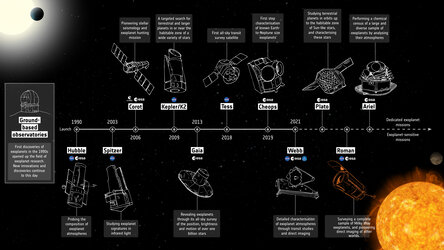
与ESA的欧几里得空间望远镜(Euclid space telescope)一样,罗曼空间望远镜将使天文学家(astronomer)能够以前所未有的细节研究宇宙。它配备了一面2.4米的主镜(primary mirror)和两台仪器:广域仪器(WFI)和日冕仪仪器技术演示装置。
Like ESA’s Euclid space telescope, Roman will enable astronomers to study the Universe in unprecedented detail. It is equipped with a primary mirror of 2.4 m and two instruments: the Wide Field Instrument (WFI) and a Coronagraph Instrument technology demonstration.
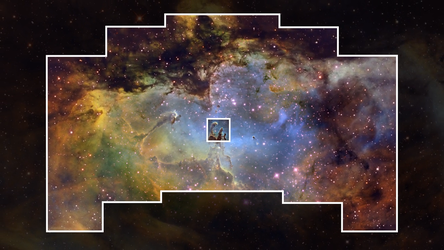
凭借其全景天空视野、清晰的红外视觉和快速重取向(re-orientation)能力,罗曼空间望远镜将对大片天空进行快速高效的巡天。通过这种方式,它将绘制随时间和空间变化的星系成团(clustering of galaxies)图,并研究来自数千颗遥远Ia型超新星(supernova)的光,这将帮助天文学家追踪宇宙膨胀(expansion of the universe)。
With its panoramic view of the sky, crisp infrared vision and quick re-orientation skills, Roman will perform fast and efficient surveys of a large area of the sky. By doing so, it will map clustering of galaxies over time and space and also study the light coming from thousands of distant type Ia supernovas which will help astronomers trace the expansion of the Universe.
“罗曼空间望远镜应该能为我们提供迄今为止最清晰的图像,以判断暗能量是真正恒定的,还是随宇宙时(cosmic time)演化的——无论哪种结果,都将对我们理解宇宙产生深远影响。我也对罗曼空间望远镜的系外行星普查感到兴奋,它将发现数千个新世界,包括迄今为止我们几乎无法触及的寒冷行星和自由飘荡行星(free-floating planet),”ESA罗曼项目科学家Bethan James说。“也许最让我兴奋的是那些意想不到的发现。凭借其深度、面积和图像质量的前所未有的结合,罗曼空间望远镜完全有机会给我们带来惊喜。”
“Roman should provide our clearest picture yet of whether dark energy is truly constant or whether it evolves over cosmic time – either outcome would have profound implications for our understanding of the Universe. I'm also excited by Roman's exoplanet census, which will discover thousands of new worlds, including cold planets and free-floating planets that have remained largely beyond our reach until now,” says Bethan James, ESA’s Roman Project Scientist. “Perhaps what excites me most is the unexpected. With its unprecedented combination of depth, area, and image quality, Roman has every opportunity to surprise us.”
发射后,罗曼空间望远镜正稳步前往距离地球(Earth)约150万公里的第二个日地拉格朗日点(Lagrange point)(L2)。这一位置使望远镜能够不受遮挡地观测约12%的广阔天空区域。与ESA的欧几里得空间望远镜和NASA/ESA/CSA韦布空间望远镜(James Webb Space Telescope)一样,罗曼空间望远镜将在L2点周围进行更宽的轨道运行——其轨道比月球(Moon)绕地球的轨道大得多。
After launch, Roman is on a steady course to the second Sun-Earth Lagrange point (L2), nearly 1.5 million km away from Earth. This location allows the telescope to have an unobstructed view of a wide area of the sky, almost 12%. Like ESA’s Euclid and the NASA/ESA/CSA James Webb Space Telescope, Roman will move in a wider orbit around the L2 point – much larger than the Moon’s orbit around Earth.
在发射后的接下来的三个月里,罗曼团队将进行一系列精心策划的部署、校准和测试。一旦调试期结束,该任务将开始其科学运行,并从发布首张科学图像开始。罗曼空间望远镜将至少花费五年时间扫描红外天空,并被设计为在太空中再工作五年。
In the next three months following launch, the Roman team will conduct a carefully orchestrated series of deployments, calibrations, and tests. Once the commissioning period is complete, the mission will begin its science operations, starting with the first science image release. Roman will spend at least five years scanning the infrared sky and is designed to work in space for another five years.
图注:2026年8月30日星期日,搭载NASA南希·格雷丝·罗曼空间望远镜的SpaceX猎鹰重型运载火箭在美国佛罗里达州肯尼迪空间中心39A发射台发射升空时凌(transit)日。
[Image description: A SpaceX Falcon Heavy rocket with NASA’s Nancy Grace Roman Space Telescope on board is seen transiting the Sun during launch from Launch Complex 39A, on Sunday 30 August 2026, at NASA’s Kennedy Space Center in Florida, US.]
来源与许可
本站仅展示标题与摘要,正文版权归原作者及原发布机构所有。 原始页面