内容提要
美国国家航天局的南希·格雷丝·罗曼空间望远镜已成功发射,目前正前往其既定轨道。该任务旨在通过其广阔的视场和红外探测能力,深入研究暗物质、暗能量及系外行星,揭示宇宙的深层奥秘。
原文全文译文
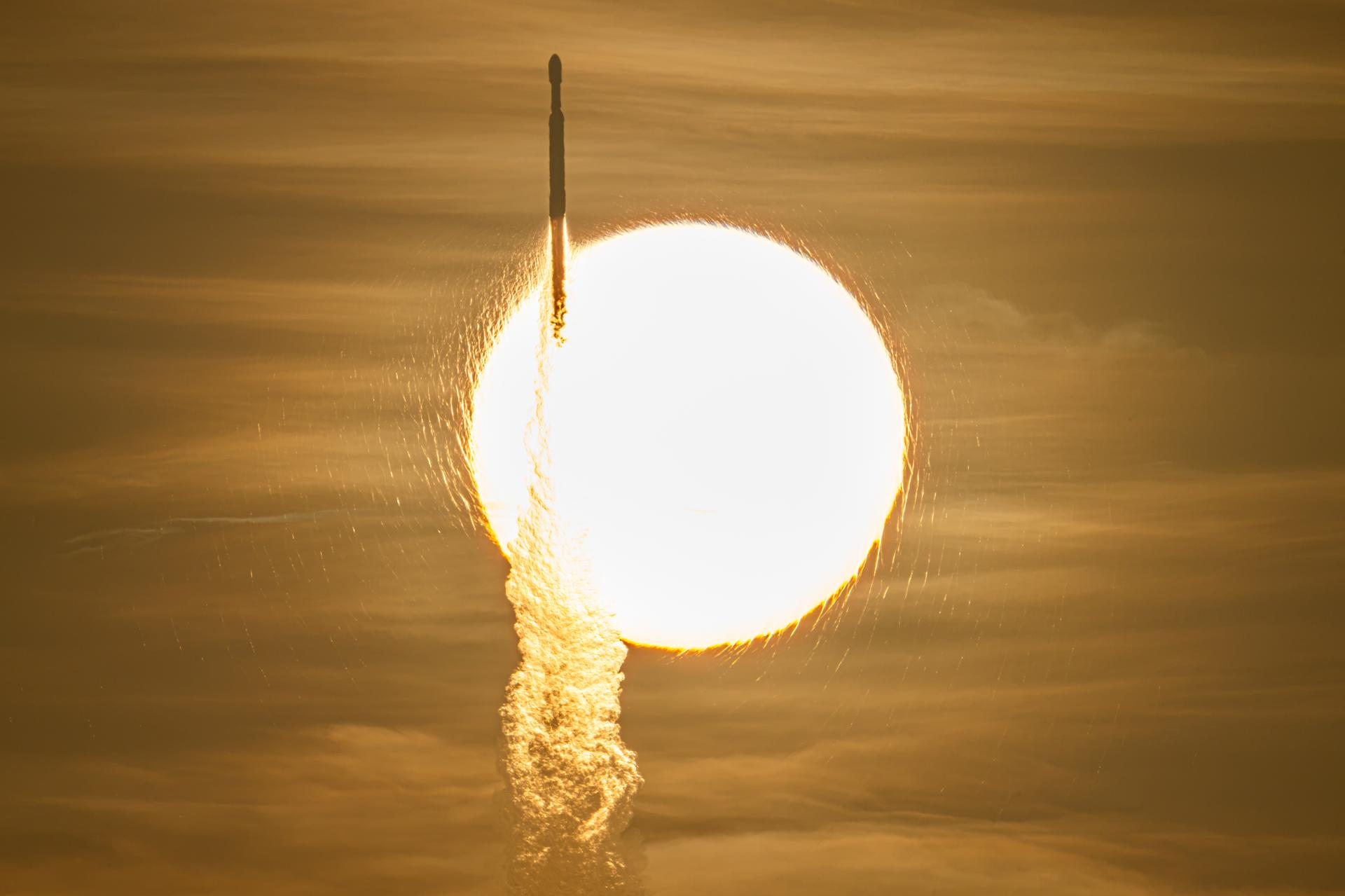
美国国家航天局(NASA)的南希·格雷丝·罗曼空间望远镜(Nancy Grace Roman Space Telescope)目前正处于为期三个月、行程一百万英里的旅途中,前往其既定轨道,它将很快揭示宇宙最黑暗的秘密。该任务于美国东部时间周日上午7:26在佛罗里达州美国国家航天局肯尼迪空间中心(Kennedy Space Center)的39A发射台,搭乘SpaceX公司的猎鹰重型火箭发射升空。
Now on a three-month, million-mile journey to its final orbit, NASA’s Nancy Grace Roman Space Telescope will soon reveal the universe’s darkest secrets. The mission launched at 7:26 a.m. EDT Sunday aboard a SpaceX Falcon Heavy rocket from Launch Complex 39A at the agency’s Kennedy Space Center in Florida.
罗曼望远镜将大视场(field of view)与清晰的红外视觉相结合,以探索广阔的天空并深入探测宇宙历史。这一旗舰任务将帮助天文学家(astronomer)探索暗物质(dark matter)、暗能量(dark energy)以及太阳系(solar system)之外的世界,即系外行星(exoplanet)。其巡天观测将支持广泛的研究,这些研究远远超出了该任务的主要科学目标。
Roman pairs a large field of view with crisp infrared vision to explore vast swaths of the sky and probe deeply into cosmic history. This flagship mission will help astronomers explore dark matter, dark energy, and worlds outside of our solar system, known as exoplanets. Its surveys will support a broad range of research extending far beyond the mission’s main science goals.
“罗曼望远镜正是我们希望在美国国家航天局看到的成功典范,”美国国家航天局局长Jared Isaacman表示。“该任务提前交付且未超预算,反映了美国国家航天局员工和我们的行业合作伙伴十多年来的奉献精神。现在,罗曼望远镜将为我们提供一份新的宇宙图集,拓展发现的边界,并展示当美国的太空计划将大胆的雄心与严谨的执行力相结合时,能够实现怎样的成就。”
“Roman is exactly the kind of success story we want to see across NASA,” said NASA Administrator Jared Isaacman. “Delivered ahead of schedule and on budget, this mission reflects more than a decade of dedication from the NASA workforce and our industry partners. Now, Roman will give us a new atlas of the universe, push the boundaries of discovery, and demonstrate what is possible when America’s space program pairs bold ambition with disciplined execution.”
位于马里兰州格林贝尔特的美国国家航天局戈达德航天中心(Goddard Space Flight Center)的地面控制团队在发射七分钟后开始接收来自罗曼望远镜的遥测数据。猎鹰重型火箭表现符合预期,在飞行31分钟后与天文台(Observatory)分离。在与中心芯级分离后,火箭助推器安全返回发射场进行翻新。
The ground control team at NASA’s Goddard Space Flight Center in Greenbelt, Maryland, began receiving telemetry data from Roman seven minutes after launch. The Falcon Heavy rocket performed as expected, separating from the observatory 31 minutes into the flight. After separating from the center core, the rocket’s boosters safely returned to the launch site for refurbishment.
“罗曼望远镜将成为一台发现机器,使我们比以往任何时候都更接近于回答人类关于宇宙历史的最深刻问题,”美国国家航天局华盛顿总部科学任务理事会副局长Nicky Fox说。“凭借其大视场和快速的巡天速度,罗曼望远镜将引领我们进入一个发现的新时代,使不可见之物变得可见,为人类寻找太阳系之外的生命奠定基础。”
“Roman will be a discovery machine that will bring us closer than ever before to answering humanity’s most profound questions about our cosmic history,” said Nicky Fox, associate administrator for the Science Mission Directorate at NASA Headquarters in Washington. “With its large field of view and fast survey speeds, Roman will usher us into a new era of discovery and make the invisible visible, setting the foundation for humanity’s search for life beyond our solar system.”
在发射和早期轨道飞行期间,罗曼望远镜使用近空间网络(Near Space Network)的地面站(ground station)和中继卫星(satellite)与地面控制人员交换跟踪、遥测和指令数据。发射约70分钟后,深空探测网(Deep Space Network)接管通信,引导罗曼望远镜前往距离地球(Earth)约一百万英里的第二个日地拉格朗日点(Lagrange point),即L2点。罗曼望远镜首先通过澳大利亚的堪培拉深空通信综合体连接到该网络。大约六小时后,它将切换到西班牙的马德里深空通信综合体,随后切换到加利福尼亚州的戈尔德斯通深空通信综合体,确保罗曼望远镜在整个旅程中保持持续联系。
During launch and early orbit, Roman uses the Near Space Network’s ground stations and relay satellites to exchange tracking, telemetry, and command data with ground controllers. About 70 minutes after launch, the Deep Space Network takes over communications and guides Roman toward the second Sun-Earth Lagrange point, or L2, about one million miles from Earth. Roman connects to that network through the Canberra Deep Space Communication Complex in Australia first. Approximately six hours later it will transfer to the Madrid Deep Space Communication Complex in Spain and then to the Goldstone Deep Space Communication Complex in California, ensuring continuous contact with Roman throughout its journey.
罗曼团队还确认,在发射一小时23分钟后,天文台的太阳能电池板(solar panel)和下部仪器遮阳罩成功展开。在接下来的几天内,罗曼望远镜的高增益天线和遮阳板式的可展开孔径盖将展开,地面控制人员将启动两次中途修正中的第一次,日冕仪(Coronagraph Instrument)也将通电。该仪器将演示未来任务(如美国国家航天局的宜居世界天文台概念)可能使用的技术,以在寻找宇宙生命的过程中对类地球行星(Earth-like planet)进行成像。罗曼望远镜的日冕仪将通过拍摄岁星(Jupiter)类行星的照片,在这一方向上迈出巨大的一步。
The Roman team also confirmed successful deployment of the observatory’s solar panels and lower instrument sun shade an hour and 23 minutes after launch. Within the upcoming days, Roman’s high-gain antenna and visor-like deployable aperture cover will deploy, ground controllers will initiate the first of two-mid-course corrections, and the Coronagraph Instrument will power on. This instrument will demonstrate the technology that future missions like NASA’s Habitable Worlds Observatory concept could use to image Earth-like planets in the search for life in the universe. Roman’s Coronagraph will take a giant step in that direction by snapping pictures of Jupiter-like planets.
在罗曼望远镜航行几周后,其主要仪器——广域仪器(Wide Field Instrument)将启动。这台300万像素的红外照相机(infrared camera)拥有18个4K探测器,每个探测器大约有一块苏打饼干大小。这些探测器收集的光子将被解码成清晰的宇宙全景图。得益于天文台刚性的设计和稳定的光学性能,它将能够快速扫描天空,而无需在不同的观测之间花费大量时间。罗曼望远镜旨在以比美国国家航天局的哈勃空间望远镜(Hubble Space Telescope)快一千倍的速度对宇宙进行巡天。
A few weeks into Roman’s voyage, its primary instrument, the Wide Field Instrument, will activate. This 300-megapixel infrared camera has 18 4K detectors, each about the size of a saltine cracker. These detectors collect photons of light that will be decoded into crisp cosmic panoramas. Thanks to the observatory’s rigid design and stable optical performance, it will rapidly scan the sky without needing substantial time between separate observations. The Roman telescope is designed to survey the universe a thousand times faster than NASA’s Hubble Space Telescope.
在罗曼望远镜三个月调试期的剩余时间里,科学家们将对仪器进行一系列的校准和测试。美国国家航天局预计在2027年初发布罗曼望远镜的首批图像。
Throughout the rest of Roman’s three-month commissioning period, scientists will run the instruments through a series of calibrations and tests. NASA anticipates releasing Roman’s first images by early 2027.
罗曼望远镜每天将传回1.4太字节的数据,这是迄今为止美国国家航天局所有天体物理任务中数据速率最高的。机器学习、人工智能和公民科学家将帮助筛选这些数据并标记重大发现,天文学家随后可以对其进行研究。
Roman will send back 1.4 terabytes of data every day, the highest data rate of any NASA astrophysics mission, so far. Machine learning, artificial intelligence, and citizen scientists will help sift through it and flag significant findings, which astronomers can then study.
“我们以前从未能用像罗曼望远镜这样的眼睛观察宇宙,”美国国家航天局戈达德航天中心罗曼望远镜高级项目科学家Julie McEnery说。“无法预知到明年这个时候,我们将知道和看到多少东西。”
“We’ve never been able to view the universe with eyes like Roman’s before,” said Julie McEnery, Roman’s senior project scientist at NASA Goddard. “There’s no telling what more we’ll know and have seen by this time next year.”
罗曼望远镜是美国国家航天局在猎鹰重型火箭上发射的第四个主要任务。今年早些时候,该机构的发射服务计划与SpaceX合作,提前了发射日期,以适应空间望远镜(space telescope)的早期完工。
Roman is the fourth primary mission NASA has launched on a Falcon Heavy rocket. Earlier this year, the agency’s Launch Services Program worked with SpaceX to accelerate the launch date to accommodate the space telescope’s early completion.
该望远镜由美国国家航天局戈达德航天中心管理,参与单位包括该机构位于南加州的喷气推进实验室(Jet Propulsion Laboratory);位于加利福尼亚州帕萨迪纳的加州理工学院/IPAC;位于巴尔的摩的空间望远镜研究所(Space Telescope Science Institute);以及来自各研究机构的科学家团队。主要工业合作伙伴包括BAE Systems Inc.、L3Harris Technologies和Teledyne Scientific & Imaging。欧洲航天局(ESA)、日本航天局(JAXA)、法国国家空间研究中心(CNES)以及德国马克斯·普朗克天文学研究所也为罗曼望远镜做出了贡献。
The telescope is managed at NASA Goddard with participation by the agency’s Jet Propulsion Laboratory in Southern California; Caltech/IPAC in Pasadena, California; the Space Telescope Science Institute in Baltimore; and a team of scientists from various research institutions. The primary industrial partners are BAE Systems Inc., L3Harris Technologies, and Teledyne Scientific & Imaging. Contributions to Roman also are made by ESA, JAXA, the French space agency CNES (Centre National d’Études Spatiales), and the Max Planck Institute for Astronomy in Germany.
欲了解更多关于罗曼任务的信息,请访问:
To learn more about the Roman mission, visit:
-end-
-end-
George Alderman / Alise Fisher
George Alderman / Alise Fisher
总部,华盛顿
Headquarters, Washington
202-358-1600
202-358-1600
Claire Andreoli
Claire Andreoli
戈达德航天中心,马里兰州格林贝尔特
Goddard Space Flight Center, Greenbelt, Md.
202-286-1940
202-286-1940
其他来源报道(1)
NASA 科学:NASA’s Dark Universe-Seeking Nancy Grace Roman Space Telescope Launches来源与许可
原文来自公共领域来源;译文由机器生成,请以原文为准。 原作者:Jennifer M. Dooren。 原始页面