查看原文全部插图(4 幅)



内容提要
南希·格雷丝·罗曼空间望远镜是一项旨在通过广阔视场探索宇宙奥秘的旗舰任务。该望远镜将前往拉格朗日点(Lagrange point)2号,通过其先进的红外照相机和日冕仪,对暗物质、暗能量及系外行星进行深入观测。
原文全文译文
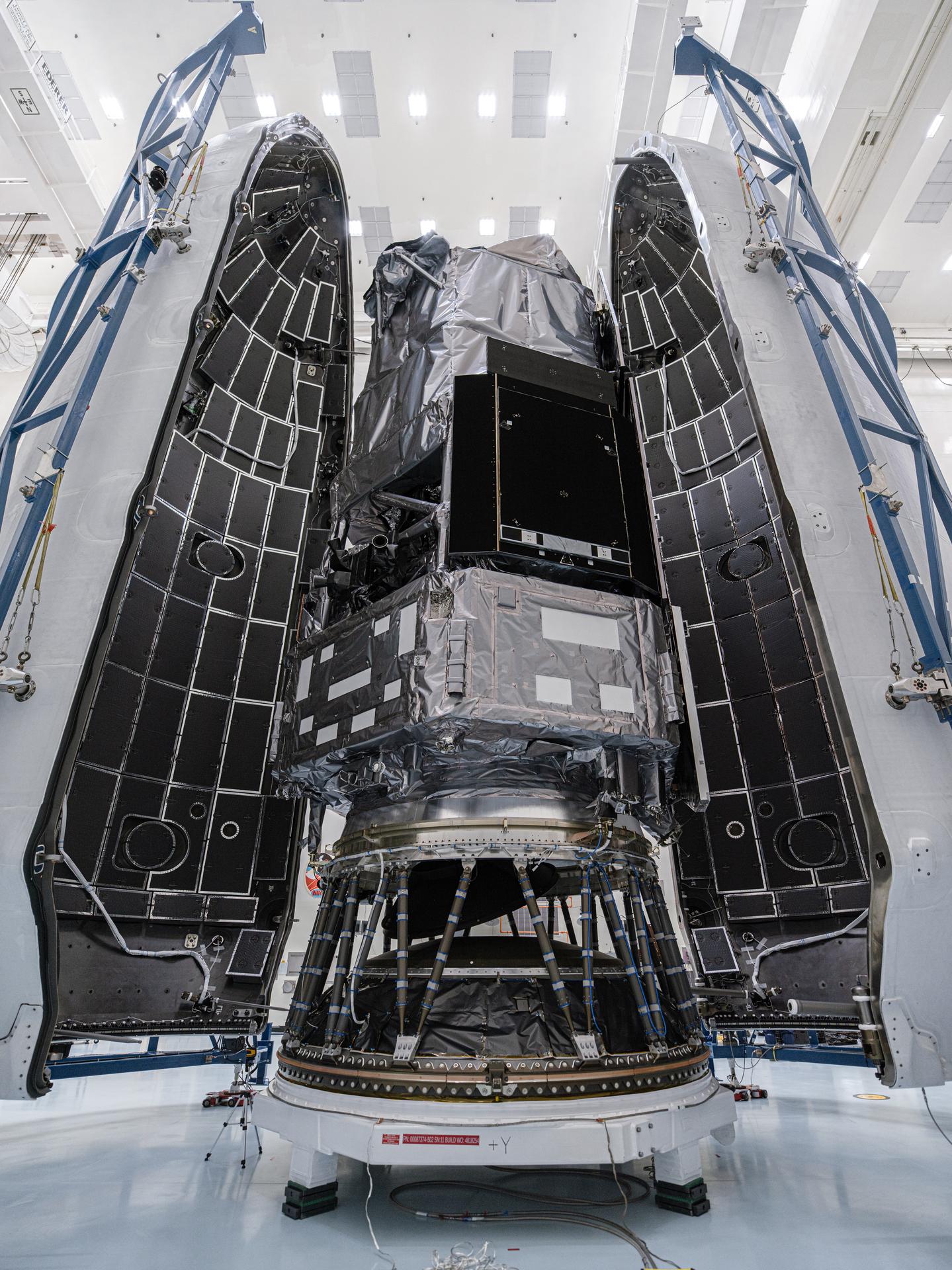
美国国家航天局(NASA)的南希·格雷丝·罗曼空间望远镜(Nancy Grace Roman Space Telescope)定于美国东部时间8月30日周日上午7:26发射。在等待观看发射的同时,不妨了解一下这项广角任务的一些关键事实。
NASA’s Nancy Grace Roman Space Telescope is set to launch at 7:26 a.m. EDT on Sunday, Aug. 30. While you wait to watch the launch, brush up on some key facts about this wide-view mission.
-
-
01
01
该任务以NASA首位首席天文学家南希·格雷丝·罗曼博士(Dr. Nancy Grace Roman)的名字命名。
The mission is named after NASA’s first chief astronomer, Dr. Nancy Grace Roman.
罗曼(Roman)以NASA首位天文学主管南希·格雷丝·罗曼博士(1925–2018)的名字命名。她倡导建立空间天文台,以便在地球(Earth)朦胧的大气层之上研究宇宙(universe),同时让科学界能够广泛获取这些数据。
Roman is named after Dr. Nancy Grace Roman (1925–2018), NASA’s first chief of astronomy. She championed space-based observatories that could study the universe above Earth’s hazy atmosphere while making their data broadly available to the scientific community.
虽然她被称为哈勃空间望远镜(Hubble Space Telescope)的“母亲”,但罗曼在NASA整个“大天文台”计划中发挥了更广泛的作用,该计划包括哈勃、钱德拉X射线天文台(Chandra X-ray Observatory)以及已退役的康普顿伽马射线天文台(Compton Gamma Ray Observatory)和斯皮策空间望远镜(Spitzer Space Telescope)。
While she’s known as the “mother” of the Hubble Space Telescope, Roman played an even broader role as the driving force behind NASA’s entire Great Observatories program, which included Hubble along with the Chandra X-ray Observatory and the retired Compton Gamma Ray Observatory and Spitzer Space Telescope.
她的远见和领导力帮助NASA确立了世界级科研机构的地位,并为一代又一代持续拓展人类对宇宙认知空间望远镜(space telescope)奠定了基础。
Her vision and leadership helped establish NASA as a world-class scientific institution and laid the foundation for generations of space telescopes that continue to expand humanity’s understanding of the cosmos.
-
-
02
02
罗曼将通过向我们展示更宏大的图景来改变我们对宇宙的看法。
Roman will transform our view of the cosmos by showing us the bigger picture.
罗曼将把大视场(field of view)与清晰的红外视觉相结合,以扫描广阔而深邃的天区。这项旗舰任务旨在帮助天文学家(astronomer)探索暗物质(dark matter)、暗能量(dark energy)以及太阳系(solar system)之外的行星,即系外行星(exoplanet)。
Roman will pair a large field of view with crisp infrared vision to scan vast, deep swaths of sky. This flagship mission is designed to help astronomers explore dark matter, dark energy, and planets outside our solar system, called exoplanets.
由于罗曼的每一次巡天都将对如此大范围的宇宙进行采样,该任务也将为天文学家进行广泛的额外科学研究提供几乎无限的机会。从外太阳系(outer solar system)的天体和爆发星(exploding star)到不断增长的黑洞(black hole)以及数十亿计的星系,几乎没有什么能超出罗曼的观测范围。罗曼的数据将在处理后立即公开,允许许多团队同时进行分析。
Since each of Roman’s surveys will sample such a large volume of the cosmos, the mission will also offer practically limitless opportunities for astronomers to conduct a broad range of additional science. From objects in our outer solar system and exploding stars to growing black holes and galaxies by the billions, very little will be beyond Roman’s reach. Roman’s data will be made public as soon as it’s processed, allowing many teams to analyze it simultaneously.
-
-
03
03
该天文台将航行一百万英里,与韦布空间望远镜(James Webb Space Telescope)在拉格朗日点(Lagrange point)2号会合。
The observatory will journey a million miles to join Webb at Lagrange point 2.
罗曼将在距离地球100万英里的第二日地拉格朗日点(L2)运行,该位置与NASA的韦布空间望远镜相同。在L2点,太阳和地球的引力与物体绕太阳运动产生的力共同作用,使其大致保持在原位。这种平衡将使罗曼在不消耗大量燃料的情况下保持相对稳定的轨道。
Roman will orbit 1 million miles away at the second Sun-Earth Lagrange point (L2), the same location as NASA’s James Webb Space Telescope. At L2, gravity from the Sun and Earth works together with an object’s motion around the Sun to hold it roughly in place. This balance will give Roman a relatively steady orbit without using much fuel.
像韦布一样,罗曼将沿着L2点周围的一条大轨道运行——其轨道比月球(Moon)绕地球的轨道大得多——而且这两台望远镜将很容易保持在很远的距离。
Like Webb, Roman will trace out a large orbit around the actual L2 point — much larger than the Moon’s orbit around Earth — and the two will easily be kept far apart.
-
-
04
04
该航天器携带了超过一百万人的名字。
The spacecraft carries the names of more than a million people.
今年夏天,每个人都被邀请提交自己的名字,以便将其添加到一个附在罗曼航天器铭牌上的存储卡中。超过130万人参与了此项活动,他们的名字将被一路带到L2点。
This summer, everyone was invited to submit their name to be added to a memory card attached to a plaque on the Roman spacecraft. More than 1.3 million people did so and will have their names carried all the way to L2.
-
-
05
05
罗曼将扫描天空至少五年。
Roman will scan the skies for at least five years.
罗曼的主要任务寿命为五年,并旨在支持额外的五年延长期任务。燃料预计将成为该任务寿命的限制性资源,虽然NASA目前没有能力在L2点为天文台提供服务,但罗曼的设计支持燃料补给。
Roman will have a primary mission lifetime of five years and is designed to support an additional five-year extended mission. Fuel is expected to be the mission’s life-limiting resource, and while NASA does not currently have an ability to service observatories at L2, Roman is designed to be refuelable.
-
-
06
06
两台仪器将促成无数发现。
Two instruments will enable myriad discoveries.
该天文台的广角仪器(Wide Field Instrument)是一台300万像素的红外照相机(infrared camera),它将赋予罗曼与哈勃相同的清晰度(角分辨率,angular resolution),但视场至少大100倍。使用该仪器,罗曼拍摄的每一张图像都将捕捉到比满月(full moon)视直径大约1.5倍的天区。
The observatory’s Wide Field Instrument is a 300-megapixel infrared camera that will give Roman the same sharpness (angular resolution) as Hubble but with a field of view at least 100 times larger. Using this instrument, each Roman image will capture a patch of the sky about 1.5 times bigger than the apparent size of a full Moon.
罗曼的日冕仪(Coronagraph Instrument)旨在演示有史以来在太空中飞行的最先进技术,用于直接成像其他恒星周围的行星。它将阻挡来自恒星的强光,使科学家能够看到绕其运行的行星反射出的微弱光线,从而揭示出比目前直接成像主要发现的炽热、年轻的系外类木行星(Jupiter-like exoplanet)更古老、更寒冷且轨道更近的巨大世界。
Roman’s Coronagraph Instrument is designed to demonstrate the most advanced technologies ever flown in space for directly imaging planets around other stars. It will block the glare from stars and make it possible for scientists to see the faint reflected light from planets in orbit around them, revealing giant worlds that are older, colder, and in closer orbits than the hot, young super-Jupiters direct imaging has mainly revealed so far.
-
-
07
07
罗曼加入了一个国际协作望远镜团队。
Roman joins an international cohort of teamworking telescopes.
罗曼将与许多其他由NASA领导的国际任务协同工作,以提供迄今为止最完整的宇宙视图。罗曼的大型全景图将发现有趣的观测目标,哈勃可以使用红外光、可见光(visible light)和紫外光(ultraviolet light)进行随动(follow-up),以提供更全面的视图。随后,NASA的韦布空间望远镜可以利用其更大的镜面和更强大的视觉,提供更详细、超清晰的观测结果。罗曼还可以观察哈勃或韦布观测目标周围的区域,以提供背景信息。
Roman will work in tandem with many other NASA-led and international missions to provide the most complete view of our universe yet. Roman’s large panoramas will uncover interesting targets that Hubble could follow up on using infrared, visible, and ultraviolet light to offer a more comprehensive view. NASA’s James Webb Space Telescope can then use its larger mirror and more powerful vision to deliver even more detailed, ultra-sharp observations. And Roman can view regions around objects Hubble or Webb observe to offer context.
欧几里得(Euclid)是一项由欧洲空间局(European Space Agency,ESA)主导、NASA做出关键贡献的任务,它将观测比罗曼更大的天区,尽管细节较少。由于它们的巡天区域会有重叠,科学家可以使用罗曼更高质量的数据对欧几里得的数据进行校正,然后将这些改进扩展到欧几里得更大的观测区域。
Euclid, an ESA (European Space Agency) mission with key contributions from NASA, will observe a larger area of the sky than Roman, though with less detail. Since their survey areas will overlap, scientists can use Roman’s higher-quality data to apply corrections to Euclid’s, then extend these refinements over Euclid’s much larger area.
科学家还可以将罗曼的红外数据与来自地面薇拉·鲁宾天文台(Vera C. Rubin Observatory)的可见光观测结果配对,该天文台是国家科学基金会(National Science Foundation)与能源部的合作项目。这将使天文学家能够更接近于在鲁宾天文台更大的天空覆盖范围内实现罗曼级的质量。
Scientists can also pair Roman’s infrared data with visible-light observations from the ground-based Vera C. Rubin Observatory, a National Science Foundation–Department of Energy collaboration. That will allow astronomers to inch closer to achieving Roman-like quality over Rubin’s much greater sky coverage.
通过展示直接拍摄系外类木行星的技术,罗曼也将为NASA的宜居世界天文台(Habitable Worlds Observatory)概念提供关键的垫脚石,这是一个旗舰空间望远镜,旨在首次拍摄其他太阳系中的类地球行星(Earth-like planet)。
By showcasing technology to directly photograph Jupiter-like exoplanets, Roman will also provide a crucial stepping stone for NASA’s Habitable Worlds Observatory concept, a flagship space telescope that would be designed to photograph Earth-like planets in other solar systems for the first time ever.
-
-
08
08
从任何地方观看罗曼发射直播。
Watch the Roman launch live from anywhere.
NASA将通过多种平台直播此次活动。了解在线观看地址:nasa.gov/live。发射广播将持续到发射后约一小时,以跟踪发射后的最初几个关键里程碑。
NASA will stream this event live through a variety of platforms. Learn where to watch online: nasa.gov/live. The launch broadcast will continue until approximately one hour past launch to follow the first several critical milestones post-launch.
-
-
09
09
NASA预计在2027年初分享罗曼的首批图像。
NASA expects to share Roman’s first images by early 2027.
罗曼团队将在发射后的三个月内完成一系列精心编排的部署、校准和测试,随后天文台(Observatory)将抵达其终轨(final orbit)。一旦这一调试期结束,科学运行便会开始,并以发布罗曼的首批科学图像作为开端。
The Roman team will complete a carefully orchestrated series of deployments, calibrations, and tests in the three months following launch before the observatory reaches its final orbit. Science operations begin once this commissioning period is completed, starting with the release of Roman’s first science images.
欲了解更多关于罗曼任务的信息,请访问:
To learn more about the Roman mission, visit:
https://www.nasa.gov/roman
https://www.nasa.gov/roman
媒体联系人:
Media contact:
Claire Andreoli
Claire Andreoli
美国国家航天局(NASA)戈达德航天中心(Goddard Space Flight Center),马里兰州格林贝尔特
NASA’s Goddard Space Flight Center, Greenbelt, Md.
301-286-1940
301-286-1940
来源与许可
原文来自公共领域来源;译文由机器生成,请以原文为准。 原始页面