查看原文全部插图(2 幅)

内容提要
本文介绍了北半球夏季夜空中著名的天鹅座,探讨了其标志性的恒星天津四、辇道增七以及天鹅圈等深空天体。此外,文章还介绍了天鹅座内著名的黑洞天鹅X-1,展示了该星座丰富的观测价值。
原文全文译文
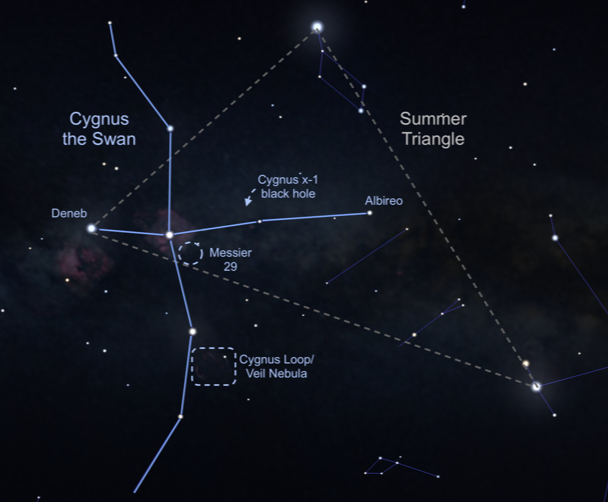
夜天(night sky)中充满了以鸟类命名的星座,其中包括雄伟的天鹅座(Cygnus)。它拥有耀眼的恒星,极易辨认,是少数几个外形与其名称相符的星座之一,且蕴藏着丰富的宝藏。整个夏季,北半球(northern hemisphere)都能观测到它,这里不仅有许多可见的天体,还有一些肉眼无法观测到的存在。要找到天鹅座,可以先从最亮的恒星天津四(Deneb)开始,它也是夏夜大三角(Summer Triangle)中最靠东北且最暗的亮星(bright star)。夏夜大三角由来自三个不同星座的三颗亮星组成——更多相关信息请阅读《夜天笔记》2022年9月刊。“天津四”是一个阿拉伯语词汇,意为“尾巴”。随后,向大三角内部移动,直到看到辇道增七(Albireo),它有时被称为夏夜大三角中心的“鸟喙星”。从这条线向两侧垂直延伸,有两颗恒星构成了十字横梁,即天鹅的翅膀,此外还有一些暗星(faint star)延伸出天鹅的双翼。
Bird constellations abound in the night sky, including Cygnus, the majestic swan. Easy to find with its dazzling stars, it is one of the few constellations that look like its namesake, and it is full of treasures. Visible in the Northern Hemisphere all summer long, there’s so much to see and even some things that can’t be seen. To locate Cygnus, start with the brightest star, Deneb, also the northeasternmost and dimmest star of the Summer Triangle. The Summer Triangle is made up of three bright stars from three different constellations – read more about it in the September 2022 issue of Night Sky Notes. “Deneb'' is an Arabic word meaning the tail. Then travel into the triangle until you see the star Albireo, sometimes called the “beak star” in the center of the summer triangle. Stretching out perpendicular from this line are two stars that mark the crossbar, or the wings, and there are also faint stars that extend the swan’s wings.
在光污染严重的夜空下,你可能只能看到最亮的几颗星,它们有时被称为北十字(Northern Cross)。在更黑暗的夜空中,标记天鹅颈部的恒星线沿着银河带(band of the Milky Way)延伸。使用双筒望远镜可以分辨出沿途的许多恒星,包括位于天鹅躯干星以南的疏散星团(open cluster of stars),编号为Messier 29。这个年轻星(young star)群由于附近受激气体的存在,可能呈现出微红色。
From light-polluted skies, you may only see the brightest stars, sometimes called the Northern Cross. In a darker sky, the line of stars marking the neck of the swan travels along the band of the Milky Way. A pair of binoculars will resolve many stars along that path, including a sparkling open cluster of stars designated Messier 29, found just south of the swan’s torso star. This grouping of young stars may appear reddish due to nearby excited gas.
让我们深入探索。虽然明亮的鸟喙星辇道增七很容易辨认,但使用望远镜(telescope)能让它展现出真正的美!它就像天空中的珠宝盒,在放大倍率下,可以看到一颗美丽的目视双星(visual double star),在同一个视场(field of view)内,一颗鲜艳的金色恒星与一颗璀璨的蓝星(blue star)交相辉映。通过望远镜或强力双筒望远镜,还可以看到另一个奇迹——天鹅圈(Cygnus Loop)。它有时被称为帷幕星云(Veil Nebula),你可以直接在天鹅东翼最后两颗恒星的上方找到这个超新星遗迹(supernova remnant)(即一颗大型垂死恒星喷射出的气体残骸)。它看起来像一个直径约三度(约为月球(Moon)直径的六倍)的微弱发光气体环。
Let’s go deeper. While the bright beak star Albireo is easy to pick out, a telescope will let its true beauty shine! Like a jewel box in the sky, magnification shows a beautiful visual double star, with a vivid gold star and a brilliant blue star in the same field of view. There’s another marvel to be seen with a telescope or strong binoculars – the Cygnus Loop. Sometimes known as the Veil Nebula, you can find this supernova remnant (the gassy leftovers blown off of a large dying star) directly above the final two stars of the swan’s eastern wing. It will look like a faint ring of illuminated gas about three degrees across (six times the diameter of the Moon).
说到早已死亡的恒星,天文学家(astronomer)在天鹅座中探测到了一个高能X射线源(X-ray source),我们无法用肉眼或业余望远镜看到它,但美国国家航天局(NASA)的钱德拉X射线天文台(Chandra X-ray Observatory)可以探测到。天鹅X-1(Cygnus X-1)于1971年的一次火箭飞行中被发现,是第一个被广泛接受为黑洞(black hole)的X射线源。这个黑洞是一颗巨星(giant star)生命周期的最后阶段,质量约为20个太阳。天鹅X-1正以惊人的速度旋转——每秒超过800次——同时吞噬着一颗近距恒星(nearby star)。从天文学角度来看,这个黑洞位于我们的邻近区域,距离我们6,070光年(light year)。但它对我们不构成威胁,只是为研究宇宙(universe)提供了一种新途径。
Speaking of long-dead stars, astronomers have detected a high-energy X-ray source in Cygnus that we can’t see with our eyes or backyard telescopes, but that is detectable by NASA's Chandra X-ray Observatory. Discovered in 1971 during a rocket flight, Cygnus X-1 is the first X-ray source to be widely accepted as a black hole. This black hole is the final stage of a giant star’s life, with a mass of about 20 Suns. Cygnus X-1 is spinning at a phenomenal rate – more than 800 times a second – while devouring a nearby star. Astronomically speaking, this black hole is in our neighborhood, 6,070 light years away. But it poses no threat to us, just offers a new way to study the universe.
今晚不妨看看你头顶那只美丽的“鸟”,将天鹅座加入你的夏季观测清单一定会让你感到欣喜,同时欢迎访问NASA的“黑洞基础”页面了解更多信息!
Check out the beautiful bird in your sky this evening, and you will be delighted to add Cygnus to your go-to summer viewing list and visit NASA’s Black Hole Basics page to learn more!
Originally posted by Dave Prosper: May 2023
Last Updated by Kat Troche: July 2026
来源与许可
原文来自公共领域来源;译文由机器生成,请以原文为准。 原始页面