查看原文全部插图(2 幅)
内容提要
南希·格雷丝·罗曼空间望远镜已抵达肯尼迪空间中心(Kennedy Space Center)的SpaceX机库,准备进行发射前的最后组装。该望远镜将通过Falcon Heavy火箭发射,旨在通过其广阔的视场探索宇宙,研究暗能量、暗物质及太阳系外的行星系。
原文全文译文
美国国家航天局(NASA)的南希·格雷丝·罗曼空间望远镜(Nancy Grace Roman Space Telescope)抵达机库
NASA’s Nancy Grace Roman Space Telescope Arrives at Hangar
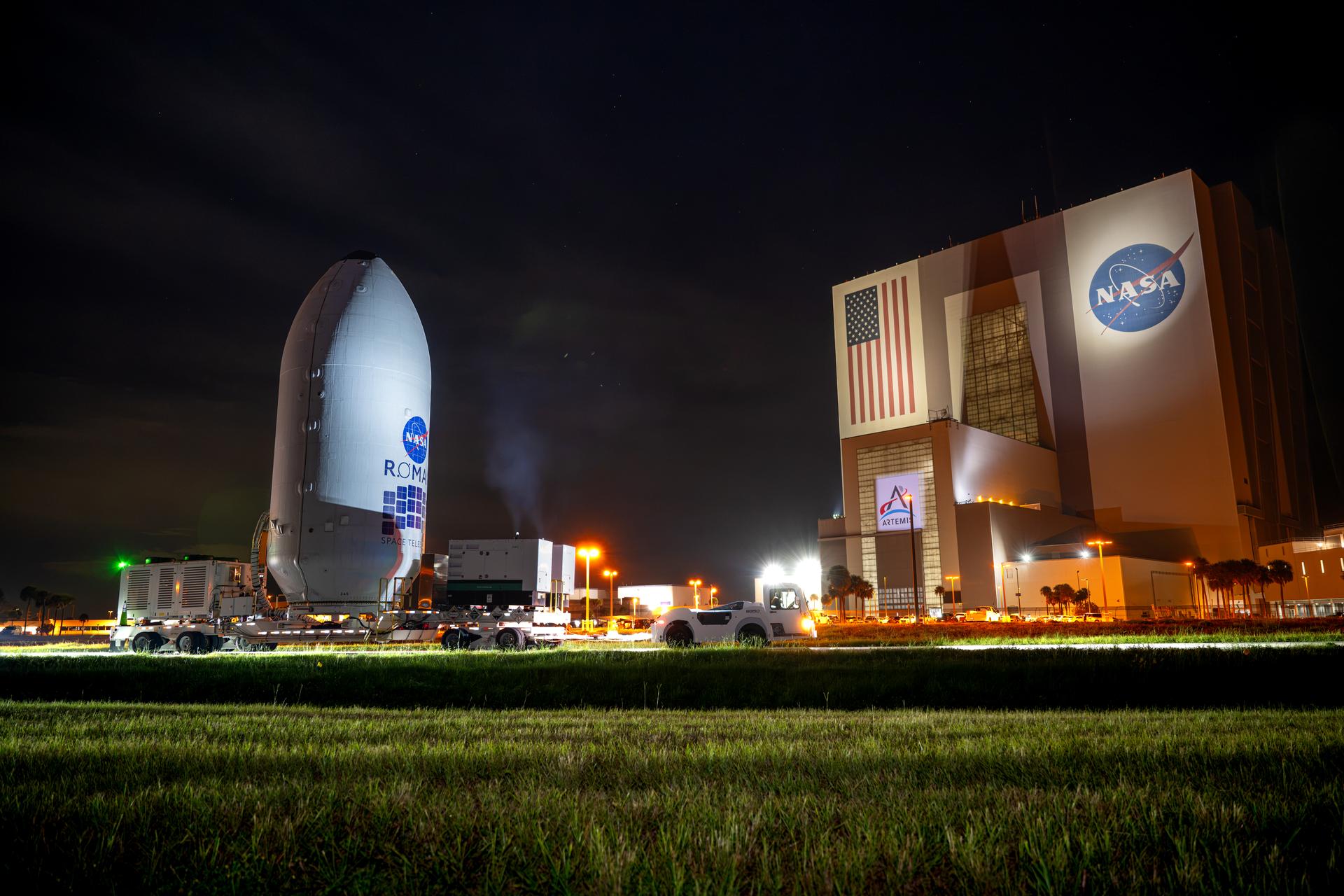
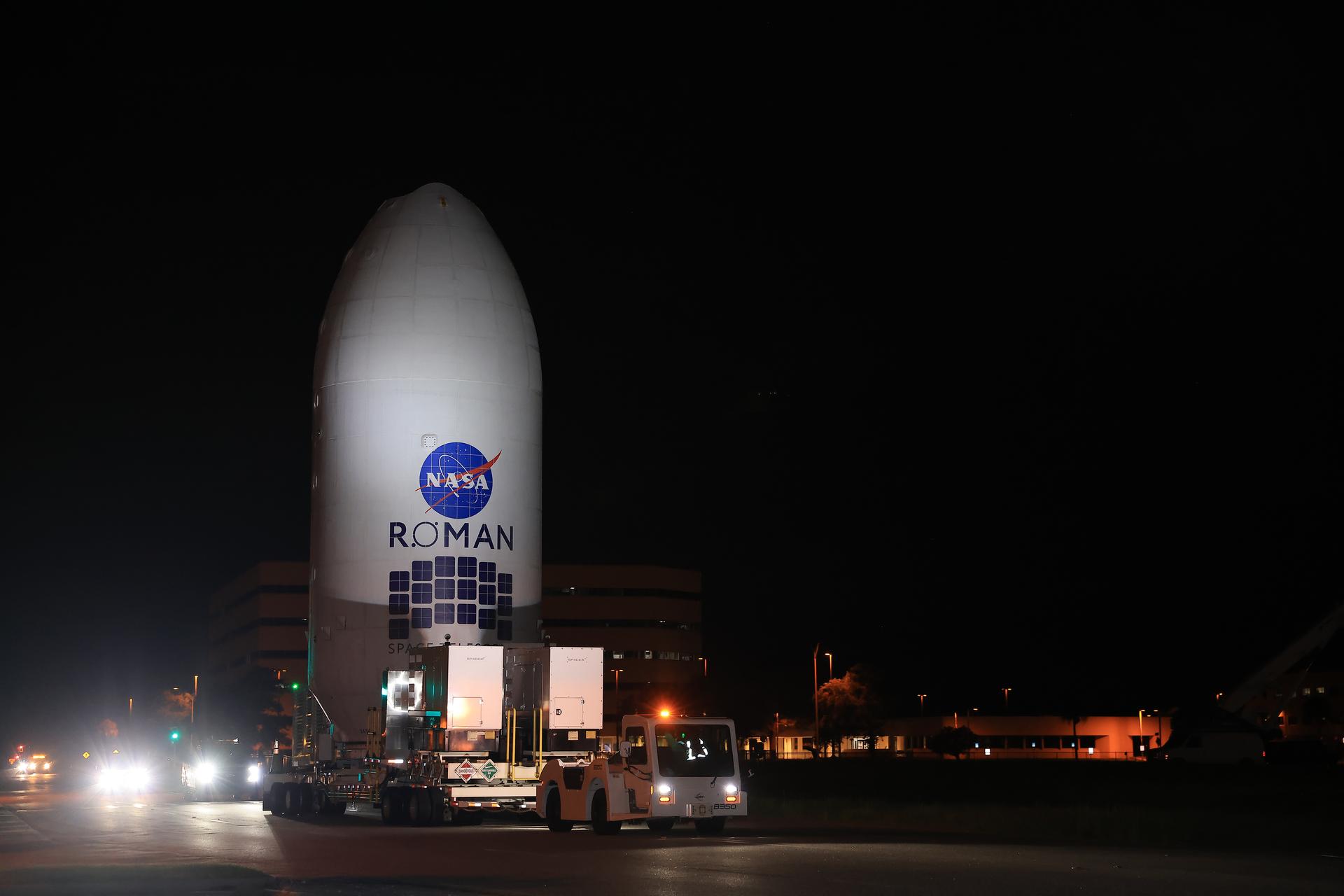
南希·格雷丝·罗曼空间望远镜于周二抵达位于佛罗里达州肯尼迪空间中心(Kennedy Space Center)39A发射台的SpaceX机库,距离其预定发射日期仅剩几天。
NASA’s Nancy Grace Roman Space Telescope arrived Tuesday to the SpaceX hangar at Launch Complex 39A at Kennedy Space Center in Florida, just days before its scheduled launch.
Roman于8月24日开始了通宵行程,从自6月以来一直进行发射前处理的有效载荷危险服务设施(Payload Hazardous Servicing Facility)出发。一支车队护送着装在Falcon Heavy整流罩内的Roman前往机库,并沿途进行监测以确保运行正常。
Roman began its overnight trip on Aug. 24, departing from the Payload Hazardous Servicing Facility, where it has been undergoing prelaunch processing since June. A convoy of vehicles escorted Roman, inside Falcon Heavy’s fairing, to the hangar, monitoring it along the way to ensure normal operations.
在接下来的几天里,团队将在机库内将Roman与SpaceX的Falcon Heavy火箭进行对接。NASA发射服务部门(Launch Services)正在管理该任务的发射准备工作,这是该项目继灵神星(Psyche)、环境应用静地卫星(GOES)-U(Geostationary Operational Environmental Satellite U)和木卫二快船(Europa Clipper)之后,第四次使用Falcon Heavy火箭发射的主要有效载荷。Roman的一个侧助推器此前曾用于GOES-U任务。
In the coming days, the team will mate Roman to the SpaceX Falcon Heavy rocket in the hangar. NASA’s Launch Services is managing the mission’s launch preparations, marking the program’s fourth primary payload launched on a Falcon Heavy rocket following Psyche, GOES-U (Geostationary Operational Environmental Satellite U), and Europa Clipper. One of Roman’s side boosters for Roman previously flew on the GOES-U mission.
NASA、Roman和SpaceX团队将于8月28日周五举行发射准备审查(Launch Readiness Review),在计划于8月30日周日美国东部时间上午7:26从肯尼迪39A发射台发射前,进行最终的“发射/中止”投票。
NASA, Roman, and SpaceX teams will host a Launch Readiness Review on Friday, Aug. 28 to conduct the final “go/no go” poll ahead of the planned 7:26 a.m. EDT launch on Sunday, Aug. 30, from Launch Complex 39A at Kennedy.
Roman比原计划提前九个月发射,预计将改变我们观察宇宙(universe)的方式,并解决关于一些最大谜团的基本问题。Roman拥有广阔的视场(field of view),一旦到达第二日地拉格朗日点(Lagrange point)2(即L2),它将迅速捕捉到充满恒星(star)和星系的广阔天空区域。
Launching nine months ahead of schedule, Roman is expected to transform the way we see the universe and settle essential questions about some of the biggest mysteries out there. Roman has a wide field of view that will rapidly capture huge swaths of sky full of stars and galaxies once it reaches second Sun-Earth Lagrange point 2, or L2.
Roman旨在研究暗能量(dark energy),即加速宇宙膨胀的神秘力量。它还将通过追踪暗物质(dark matter)的影响,绘制星系如何形成、聚集和演化的图谱。此外,Roman将发现并研究太阳系(solar system)之外的行星(planet),其精度足以完成对我们银河系中行星系(planetary system)的统计普查。
Roman is designed to investigate dark energy, the mysterious force accelerating the universe’s expansion. It will also map how galaxies form, cluster, and evolve by tracing the influence of dark matter. In addition, Roman will discover and study planets beyond our solar system with the precision needed to compete a statistical census of planetary systems in our galaxy.
关注任务更新:
Follow along for mission updates:
X: @NASARoman, @NASAUniverse, @NASAKennedy
X: @NASARoman, @NASAUniverse, @NASAKennedy
Facebook: @NASARoman, @NASAGoddard, @NASAKennedy
Facebook: @NASARoman, @NASAGoddard, @NASAKennedy
Instagram: @NASAGoddard, @NASAUniverse, @NASAKennedy
Instagram: @NASAGoddard, @NASAUniverse, @NASAKennedy
来源与许可
原文来自公共领域来源;译文由机器生成,请以原文为准。 原作者:Elyna Niles-Carnes。 原始页面