
查看原文全部插图(5 幅)



内容提要
由美国国家航天局(NASA)主导的南希·格雷丝·罗曼空间望远镜(Nancy Grace Roman Space Telescope)计划于 2026 年 8 月 30 日发射。该望远镜凭借其广阔的视场和先进的光学设计,将深入探索暗能量、暗物质以及系外行星等天文学核心课题。
原文全文译文
由美国国家航天局(NASA)主导的南希·格雷丝·罗曼空间望远镜(Nancy Grace Roman Space Telescope)定于 2026 年 8 月 30 日 07:26 EDT / 12:26 BST / 13:26 CEST 从美国佛罗里达州的肯尼迪空间中心(Kennedy Space Center)发射。
The NASA-led Nancy Grace Roman Space Telescope is set to launch on 30 August 2026 at 07:26 EDT / 12:26 BST / 13:26 CEST from NASA’s Kennedy Space Center in Florida, USA.
凭借其广阔的视场(field of view)和先进的光学设计(optical design),Roman 望远镜将对天空进行从可见光到近红外(near-infrared)波段的详细扫描。通过这些观测,Roman 将有助于揭示暗能量(dark energy)和暗物质(dark matter)的本质,并发现新的系外行星(exoplanet)。
With its wide field of view and advanced optical design, the Roman telescope will conduct detailed scans of the sky in visible to near-infrared light. In doing so, Roman will help reveal the nature of dark energy and dark matter and find new exoplanets.
“欧洲航天局(ESA)正在为 Roman 提供关键硬件,包括航天器的恒星追踪器、电池、日冕仪仪器的探测器,以及通过其深空(deep space)地面站(ground station)网络提供的通信支持,”ESA 的 Roman 项目科学家 Bethan James 表示。“通过‘机会任务’(Mission of Opportunity)计划,欧洲贡献了科学专业知识,帮助指导并最大化该任务的科学回报。”
“ESA is contributing essential hardware to Roman, including the spacecraft's star trackers, batteries, detectors for the coronagraph instrument, and communications support through its deep-space ground station network,” says Bethan James, ESA’s Roman Project Scientist. “Through the Mission of Opportunity programme, Europe contributes scientific expertise, helping guide and maximise the mission's scientific return.”
ESA 还将利用位于澳大利亚新诺西亚(New Norcia)的新型 35 米天线,实现从 Roman 下载数据。
ESA will also enable data download from Roman using the new 35-metre antenna in New Norcia, Australia.
回望早期宇宙(early Universe)
Looking back at the early Universe
Roman 将在红外光下对天空进行快速、详细的扫描。这将揭示关于早期宇宙及其随时间演化过程的大量信息。
Roman will conduct fast, detailed scans of the sky in infrared light. This will reveal a lot about the early Universe and how it expanded over time.
“它将结合哈勃(Hubble)质量的成像能力与超过 200 倍的视场,使其能够研究数十亿颗恒星(star)、数百万个星系、数千颗系外行星,以及广阔的、此前未被探索的太空区域,”Bethan 解释道。“这将使天文学家(astronomer)能够解决天体物理学中一些最大的未解之谜,从暗能量的本质到我们银河系(Milky Way galaxy)中行星的丰度。”
“It will combine Hubble-quality imaging with a field of view more than 200 times larger, allowing it to study billions of stars, millions of galaxies, thousands of exoplanets, and vast regions of previously unexplored space,” explains Bethan. “This will enable astronomers to address some of the biggest open questions in astrophysics, from the nature of dark energy to the abundance of planets throughout our Milky Way galaxy.”
暗物质与暗能量
Dark matter and dark energy
宇宙(universe)中约 25% 的物质似乎由不可见的暗物质组成。暗物质的存在只能通过它如何影响星系的表观形状来“观察”。来自遥远星系的光由于暗物质团块的存在而发生弯曲和畸变,使星系看起来略微扭曲。这种效应被称为弱引力透镜(weak gravitational lensing)。
About 25% of the Universe appears to be made up of invisible dark matter. The presence of dark matter can only be ‘seen’ by how it affects the apparent shape of galaxies. Light from a distant galaxy is bent and distorted due to the presence of clumps of dark matter, making the galaxy look slightly warped. This effect is called weak gravitational lensing.
Roman 的主要任务之一是扫描银河系平面上方约 12% 的天空,以寻找数百万个遥远星系中的透镜效应(lensing effect)。通过研究星系形状的微小变化,Roman 将帮助天文学家精确绘制普通物质和暗物质在宇宙历史中的分布,并追踪星系的演化过程。
One of Roman’s main tasks will be to scan about 12% of the sky high above our galactic plane to look for the lensing effect in millions of distant galaxies. By studying tiny changes in the shapes of galaxies, Roman will help astronomers accurately map the distribution of ordinary and dark matter across the history of the Universe and trace how galaxies evolved.
Roman 将调查宇宙随时间推移是如何膨胀的。这种膨胀似乎正在加速,而暗能量似乎是罪魁祸首。科学家认为暗能量约占宇宙的 70%,但其本质仍然是一个谜。与 ESA 的 Euclid 任务一样,Roman 将使用多种方法来帮助我们理解暗能量是什么以及它是如何随时间演化的。
Roman will investigate how the Universe has expanded over time. The expansion appears to be speeding up, and dark energy seems to be the culprit. Scientists think that dark energy makes up about 70% of the Universe and yet its nature remains a mystery. Like ESA's Euclid, Roman will use multiple methods to help us understand what dark energy is and how it has evolved over time.
在其中一种方法中,Roman 将在遥远星系中寻找被称为超新星(supernova)的爆发星(exploding star),特别是 Ia 型超新星。由于这些爆炸在峰值时的亮度是可预测的,天文学家可以利用它们来测量宇宙距离(cosmic distance),进而提供关于宇宙膨胀速度的见解。
In one method, Roman will look for exploding stars known as supernovas, in distant galaxies, especially type Ia supernovas. Because these explosions peak at a predictable brightness, astronomers can use them to measure cosmic distances, which in turn provide insights into how fast the Universe is expanding.
在另一种方法中,Roman 将绘制星系在时间和空间上如何聚集的地图,以测试暗能量对它们的影响。Roman 将研究重子声学振荡(baryonic acoustic oscillation)——即曾经在极早期宇宙(very early universe)中涟漪般传播的声波(sound wave)留下的印记。
In another method, Roman will map how galaxies cluster together in time and space to test the effect of dark energy on them. Roman will study baryonic acoustic oscillations – imprints of sound waves that once rippled through the very early Universe.
随着宇宙冷却,这些涟漪被冻结在原地。随着时间的推移,星系团沿着冻结的涟漪形成。最终,随着宇宙膨胀,涟漪被拉伸,周围星系之间的距离增加。通过观察星系在宇宙距离上的分布方式,天文学家可以研究宇宙随时间推移是如何膨胀的。这将进一步阐明暗能量的本质。
As the Universe cooled, these ripples froze in place. Over time clusters of galaxies formed along the frozen ripples. Eventually, as the Universe expanded, the ripples stretched, and the distance between the surrounding galaxies increased. By looking at how galaxies are distributed across cosmic distances, astronomers can study how the Universe expanded over time. This will further shine a light on the nature of dark energy.
系外行星
Exoplanets
Roman 的另一项任务是寻找系外行星,包括像我们这样的行星系(planetary system)。利用其深邃而广阔的视场,Roman 将深入观察我们银河系的核心。通过这样做,它将追踪来自数百万颗恒星的光量,并研究光强随时间的变化。
Another task of Roman will be to look for exoplanets including planetary systems like our own. Using its deep and wide field of view, Roman will peer into the heart of our own galaxy. By doing so, it will track the amount of light coming from millions of stars and study how the intensity of light changes over time.
Roman 将密切关注微引力透镜事件,这些事件可能会揭示超过 1200 个新世界。同时,该望远镜预计将发现超过 100,000 颗凌星行星(transiting planet),当这些行星从宿主星(host star)前方经过时,会使宿主星的光线变暗。Roman 先进的日冕仪仪器将允许天文学家通过遮挡宿主星的光线,直接对一些系外行星进行详细成像,即使行星比其宿主星暗 1 亿倍以上。
Roman will keep an eye on microlensing events that may reveal over 1200 new worlds. At the same time, the telescope is expected to reveal more than 100 000 transiting planets that dim the light of their host stars when the planets cross in front of them. Roman’s advanced coronagraph instrument will allow astronomers to directly image some of the exoplanets in detail by blocking the host stars’ light, even when the planet is over 100 million times fainter than its host star.
极端宇宙天体
Extreme cosmic objects
Roman 非常灵敏,它还将探测极端事件,例如中子星(neutron star)合并时黑洞(black hole)的诞生,以及潮汐瓦解事件(tidal disruption event)。该任务还将观测在其中心拥有极亮类星体(quasar)的活动星系(active galaxy),以及来自再电离时期的一些暗淡的遥远类星体。
Roman is so sensitive that it will also detect extreme events, such as the birth of black holes when neutron stars merge, and tidal disruption events. The mission will also observe active galaxies hosting extremely bright quasars at their centres and several faint faraway quasars from the period of reionisation.
太空中的广角望远镜
Wide-eyed telescope in space
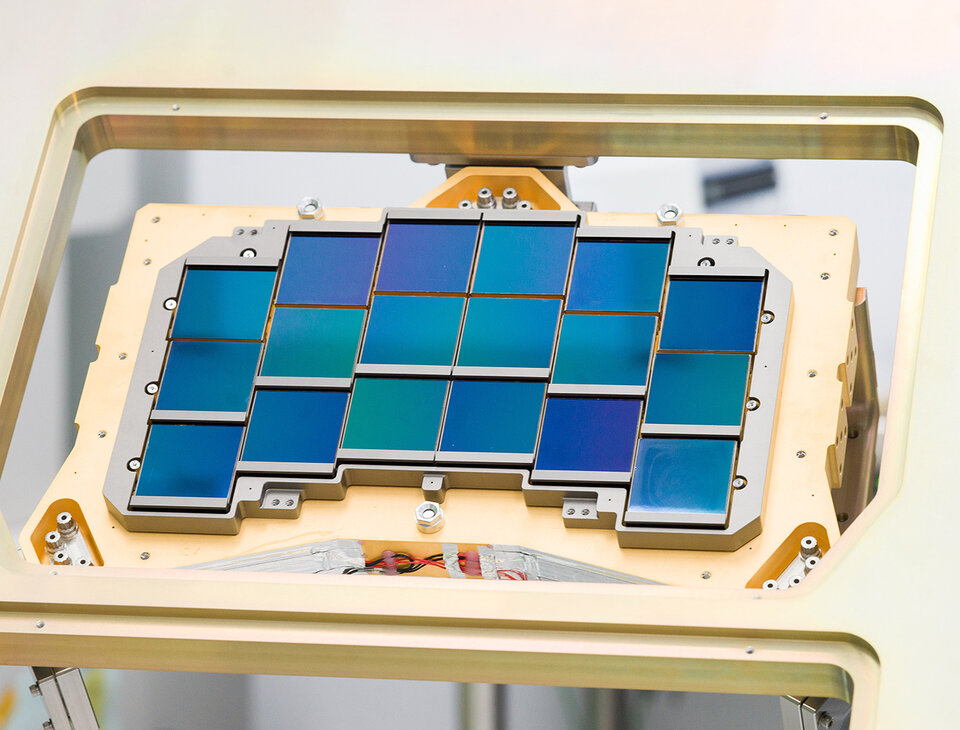
Roman 望远镜配备了一面直径为 2.4 米的主镜(primary mirror)。该望远镜有两个主要仪器:广角仪器(WFI)和日冕仪仪器。WFI 是一台 3 亿像素的多波段(multi-band)可见光和近红外照相机(infrared camera),能够获得极其匀边像(crisp image)和非常灵敏的光谱数据。
The Roman Telescope is equipped with a primary mirror of 2.4 m in diameter. The telescope has two main instruments: the Wide Field Instrument (WFI) and a Coronagraph Instrument. The WFI is a 300-megapixel multi-band visible and near-infrared camera capable of obtaining extremely crisp images and very sensitive spectroscopic data.
日冕仪仪器是一种高性能技术演示器,它通过遮挡星光来寻找周围暗淡的行星。该仪器可能能够直接对围绕宿主星运行的、处于类似木星(Jupiter)轨道的木星大小的系外行星反射的星光进行成像。
The Coronagraph Instrument is a high-performance technology demonstrator that blocks out starlight to look for faint planets around them. The instrument could be capable of directly imaging reflected starlight from Jupiter-sized exoplanets in Jupiter-like orbits around their host stars.
“每当天文学为宇宙打开一扇新窗户时,历史表明,一些最重要的发现往往是我们从未预料到的,”Bethan 评论道。“凭借其在深度、面积和图像质量方面前所未有的结合,Roman 有充分的机会给我们带来惊喜。”
“Whenever astronomy opens a new window on the Universe, history has shown that some of the most important discoveries are the ones we never anticipated,” remarks Bethan. “With its unprecedented combination of depth, area and image quality, Roman has every opportunity to surprise us.”
在此处关注发射直播
Follow the launch live here
Roman计划于2026年8月30日07:26 EDT / 12:26 BST / 13:26 CEST,搭乘SpaceX猎鹰重型运载火箭(SpaceX Falcon Heavy rocket)从位于美国佛罗里达州的美国国家航天局(NASA)肯尼迪空间中心(Kennedy Space Center)发射升空。请通过NASA的YouTube频道观看发射直播。关注NASA以获取最新动态。
Roman is scheduled to launch on a SpaceX Falcon Heavy rocket from NASA’s Kennedy Space Center in Florida, USA on 30 August 2026 at 07:26 EDT /12:26 BST / 13:26 CEST. Watch the launch live via NASA’s YouTube channel. Follow NASA for updates.
如需更多信息,请联系:
For more information, please contact:
ESA媒体关系部
ESA Media Relations
电子邮件:[email protected]
Email: [email protected]
来源与许可
本站仅展示标题与摘要,正文版权归原作者及原发布机构所有。 原始页面